Video AI research
How Context-Matched Distillation stops video teachers from seeing the future
Video distillation has long trained causal students against teachers that score whole clips with future knowledge. CMD replaces that scoring with a causal teacher, adds prefix-scored targets, and reports state-of-the-art results among autoregressive methods.
Emmanuel Fabrice Omgbwa Yasse AI-assisted
2026-08-14 · Last updated: 2026-08-16 · 5 min read
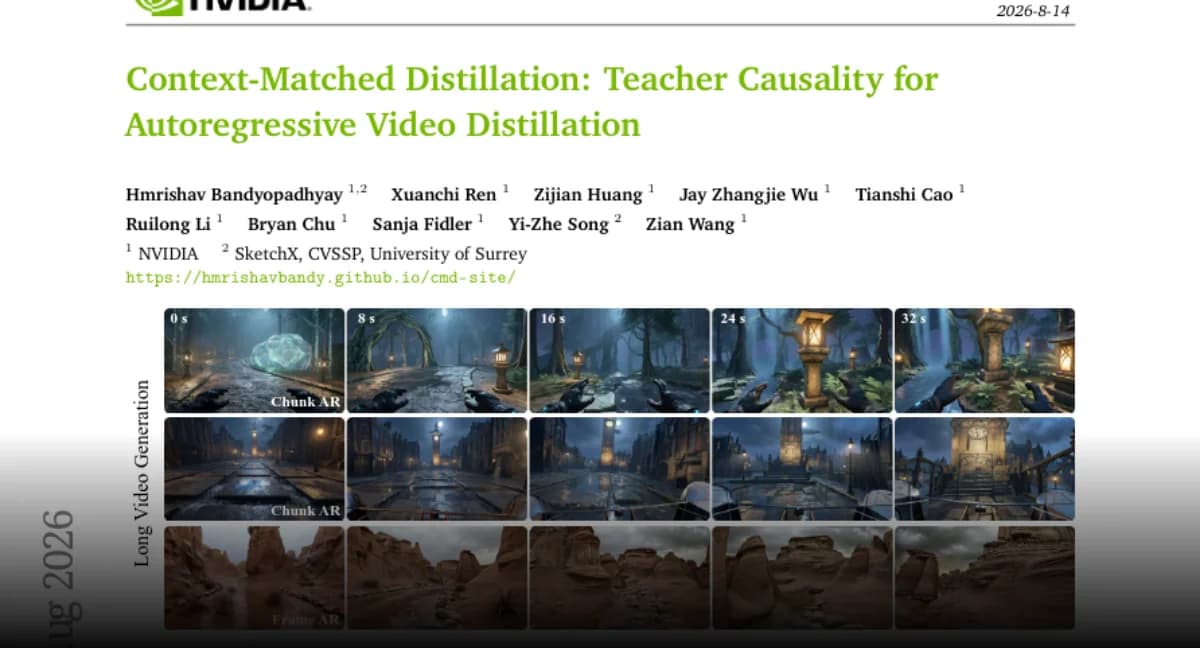
Interactive video generation has a clock problem. The model must produce each frame conditioned only on what came before; everything after is, from its point of view, still unwritten. The distillation pipelines used to train those models often ignore that constraint. A bidirectional teacher scores the student's output against a complete clip, including frames the student could not have known about when it generated its target.
That mismatch is the subject of a new paper, Context-Matched Distillation: Teacher Causality for Autoregressive Video Distillation, posted on Hugging Face. The argument is straightforward: if a few-step student can only see the past, its teacher should only see the past too. The paper's method, Context-Matched Distillation (CMD), enforces exactly that and reports state-of-the-art aggregate results among autoregressive methods on short- and long-video benchmarks.
Why video distillation teachers could see the future
Few-step distillation exists to make interactive video generation fast, cutting the number of denoising steps each rollout needs. The catch is that online control, the thing the interactive use case demands, imposes a causal constraint: frames and blocks may depend only on history and controls available at generation time.
Standard video distribution matching distillation (DMD) pipelines do not extend that constraint to the teacher. They supervise causal few-step students with bidirectional teachers that score entire clips. The score assigned to a target can therefore depend on future frames and controls that were unavailable when the student generated that target. The student is being trained to match a score computed with more information than it will ever have at runtime.
The problem shows up in related work from the student side. In our coverage of NVIDIA's Cosmos-H-Dreams, a distillation project aimed at real-time surgical simulation, a model that conditions on its own imperfect outputs lets small errors compound over time. The fix there is self-forcing distillation: the student rolls forward on its own generated context under supervision from a frozen teacher. CMD takes the other route. It leaves the student as is and changes what the teacher is allowed to see.
Three mechanisms, one causal premise
CMD rests on a single premise: teacher supervision should match the information available when each target is generated. Three mechanisms follow.
The first is the causal teacher. Where existing pipelines score full clips, CMD's teacher evaluates each target without access to any future frame or control. The same causal teacher also initializes the few-step student, so teacher training, student distillation, and inference share one causal formulation. No part of the pipeline gets a lookahead the student will not have at runtime.
The second mechanism, prefix scoring, handles a subtler mismatch. During interactive generation the student does not build on ground truth; it builds on its own previously generated output. Prefix scoring evaluates each target under the cached student-generated prefix that actually produced it, tying supervision to the student's realized rollout context rather than an idealized one.
That setup creates an instability problem, because early rollouts produce unreliable prefixes. The third mechanism, prefix corruption, perturbs those early prefixes to stabilize training while preserving the alignment between a target and its generation context.
Because the causal formulation never changes, CMD also extends naturally to frame-wise and chunk-wise generation, to long-video distillation, and to camera-conditioned distillation.
The instability has a known counterpart in language-model distillation. Our analysis of Flux-OPD found that evolving contexts push context-conditioned teachers in different directions, and that the reverse KL objective carries a conflict term measuring that divergence. CMD faces a similar instability in the video setting, where the unstable element is the student's own rollout.
What the benchmarks show, and the caveat attached
The reported results are strong, with one qualifier worth underlining. CMD achieves state-of-the-art aggregate performance among autoregressive methods on short- and long-video benchmarks, plus substantially improved adherence to time-varying camera controls. "Among autoregressive methods" does real work there. The claim does not say how a CMD-distilled model compares with non-autoregressive approaches to interactive video generation.
The camera-control result carries the practical weight. Interactive video is sold on steering a scene in real time, and camera movement is the most direct form of steering. Better adherence to time-varying controls is the clearest sign that removing the teacher's lookahead pays off where it should: when the user moves the camera mid-rollout, the model has no excuse to be surprised.
Open questions the paper leaves on the table
Three questions follow from the paper's own framing. The non-autoregressive comparison is simply not there: whether causal distillation would transfer to other generation families, and how a CMD-distilled model would fare head to head against one, is left to follow-up work. The cost of the constraint is unquantified: removing future access from the teacher is information discarded by construction, and for tasks where the full clip is known in advance, such as offline editing, a bidirectional teacher might still have something to offer. And the abstract reports quality gains, not latency arithmetic: prefix scoring depends on cached prefixes, and what that adds to the per-rollout budget is not broken down. The economics of per-generation cost are a live concern elsewhere in the field, as the billed-by-the-second pricing of Wan3.0-Video shows.
Where CMD sits in the broader distillation conversation is clearer. Self-forcing students, on-policy context matching, and now teacher causality all point one way: generative distillation improves when training conditions match the conditions the model will actually run under. That same principle is showing up on the world-model side, where PhiZero learns a physical language from raw video to reason before rendering, and where VideoCoCo scripts scenes as Blender code so a simulator plays them out. CMD simply makes the teacher obey the same clock as the student. That a conceptually simple fix wins benchmarks suggests how much misalignment the field had been quietly tolerating.
- Source : How Context-Matched Distillation stops video teachers from seeing the future — 2026-08-14
Get the tech essentials in 3 minutes every morning
One email, every weekday, with what actually matters in AI and tech.