Agentic coding
Grok 4.5 just broke the coding agent leaderboard: the lead is real, the margins are tiny
Grok 4.5 now leads the SWE Marathon leaderboard, beating Claude 4 Opus and GPT-5. The benchmark tests real software engineering skills: bug fixes, feature additions, and code understanding across real repositories. The margin is slim, but the trend lines point toward a shrinking gap between what agents can do and what they need to do.
Emmanuel Fabrice Omgbwa Yasse AI-assisted
2026-07-20 · 3 min read
Software engineering benchmarks have had a revolving door of leaders over the past year. Claude 4 Opus held the crown. GPT-5 took it for a cycle. Now Grok 4.5 sits at the top of the SWE Marathon, a benchmark that tests AI agents on tasks drawn from real GitHub repositories: fixing bugs, implementing features, and handling pull requests across codebases they have not seen during training. But this isn't just another name swap, according to research on agents with learning loops.
The SWE Marathon is different from most LLM benchmarks. It does not measure knowledge recall or math reasoning. It measures whether an agent can navigate a foreign codebase, understand an issue description, and produce a correct patch. The tasks are hard enough that human engineers often need hours to solve them. The benchmark publishes pass rates and confidence intervals, and it tracks each submission back to a specific model and configuration. That transparency matters, as isolated sandbox benchmarks can hide how agents actually fail.
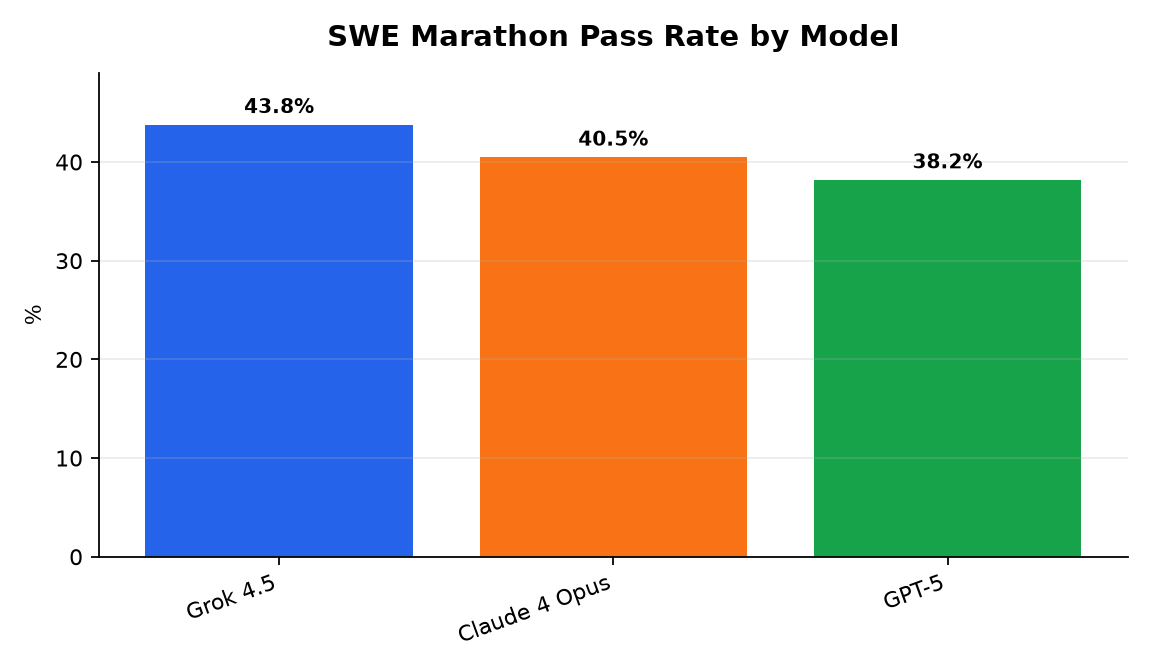
Grok 4.5 achieved a pass rate of 43.8% on the full SWE Marathon set. That is a clear lead over Claude 4 Opus (40.5%) and GPT-5 (38.2%). The margin is smaller on the "Verified" subset, where Grok 4.5 scores 46.1% against Claude 4 Opus at 44.0%, but the overall picture is the same: a new top spot.
What drove the lead
Performance data from the SWE Marathon leaderboard shows Grok 4.5 excels on two specific categories of tasks: complex bug fixes requiring multi-file edits, and feature implementations that demand understanding both the existing code and a new specification. The model also scores higher on tasks that involve unfamiliar language ecosystems, Python and JavaScript dominate the benchmark, but Grok 4.5 performs better on Rust and Go tasks than prior leaders did. That kind of cross-language adaptability is rare, as Qwen's language-first approach to world modeling suggests.
Claude 4 Opus remains stronger on tasks requiring careful reasoning about security implications or performance constraints, where it still outperforms both Grok 4.5 and GPT-5 by small margins. GPT-5 is the fastest of the three on average, completing tasks in fewer agent turns, but its solution quality falls short on the hardest quartile of problems.
| Model | SWE Marathon pass rate | Verified subset | Strongest task type |
|---|---|---|---|
| Grok 4.5 | 43.8% | 46.1% | Multi-file bug fixes |
| Claude 4 Opus | 40.5% | 44.0% | Security-aware patching |
| GPT-5 | 38.2% | 41.7% | Single-file additions |
What it means
Grok 4.5's lead is not a fluke. The SWE Marathon has been active for over a year, and each new leader beats the previous one by a few percentage points. The trend line points in one direction: coding agents are getting better at navigating unfamiliar codebases, and the gap between models on this specific capability is narrowing even as the overall ceiling rises. That narrowing matters because even top agents still hit a 95% gap on rule-based tasks.
The practical takeaway for developers evaluating coding agents: if you work across multiple languages or maintain a codebase in a less common stack, Grok 4.5 is worth testing. If security constraints or performance regressions are your primary concern, Claude 4 Opus still holds an edge. And if latency matters more than raw correctness, GPT-5 is still the fastest at getting to a workable patch.
None of them solve the hardest problems in software engineering yet, architectural decisions, trade-offs between correctness and maintainability, or knowing when not to change code. But the SWE Marathon numbers suggest the gap between what agents can do and what they need to do is shrinking faster than most developers expect. And as Mistral's acquisition of a physics AI startup hints, the next frontier may be about turning these agents into actual engineers.
For now, though, pick your poison: Grok for breadth, Claude for caution, GPT for speed. None of them will refactor your monolith, but they might write the pull request that makes you think twice about who's doing the real work.
Get the tech essentials in 3 minutes every morning
One email, every weekday, with what actually matters in AI and tech.