product update
Copilot just learned what good code looks like, not just valid code
GitHub turned a 40,000-star open-source project into a native Copilot skill. The integration targets design quality in AI-generated code, aiming to raise the ceiling while the floor is already covered.
Emmanuel Fabrice Omgbwa Yasse AI-assisted
2026-07-22 · Last updated: 2026-07-30 · 2 min read
GitHub made Impeccable AI a native skill inside its Copilot app on Tuesday, folding a project that had already climbed past 40,000 stars into the default toolkit of every Copilot subscriber. The announcement, posted on X, frames the move as a deliberate pivot: AI, the argument goes, has already raised the floor for what developers can produce. Impeccable is there to help raise the ceiling.
GitHub isn't selling speed or boilerplate avoidance here; those are table stakes. Instead, the company is betting that teams will pay for taste. Impeccable's pitch was never just "faster code." The project earned its reputation on design quality: clean UI components, consistent spacing, sensible layout choices that don't make a developer's work look assembled by a Markov chain. Codifying that into a Copilot skill means the suggestion engine now carries a visible preference for visual coherence alongside syntactic correctness. As a recent coding benchmark showed, structured tasks still favor models that prioritize presentation logic, echoing known limitations in benchmark design.
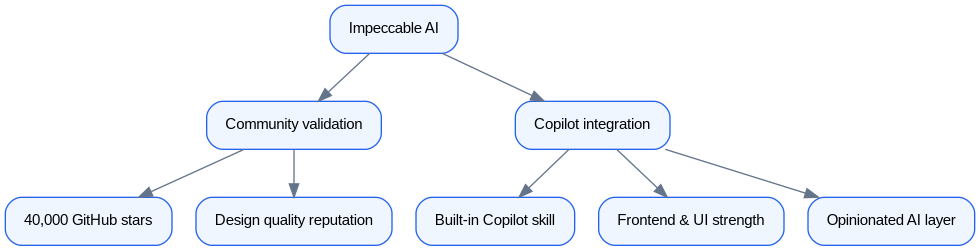
Impeccable proved its value in the open; stars are a coarse but real signal of community adoption. Bringing it in-house is a low-risk way to expand Copilot's relevance beyond backend logic and into the frontend and design layers where AI has historically been weaker. It's the same playbook Microsoft has used with other community-born features: validate externally, absorb internally. The same cost-conscious strategy has informed Microsoft's broader Copilot experimentation, as seen in its in-house model cost reductions.
The move doesn't come with a detailed technical changelog. GitHub's post is light on specifics about how Impeccable's design heuristics are surfaced or whether they can be tuned per project. Those questions will matter once teams try the skill in production, where one team's "sensible spacing" is another's "wasted pixels." The challenge echoes broader issues in cleaning input before generation.
GitHub is adding opinion to its AI layer: not just generating code, but generating code that looks like it was written by someone who cares how it reads on screen. That goes beyond syntax completion, and Impeccable's track record suggests GitHub can pull it off. The mindset aligns with orchestration over raw model size; speed alone isn't enough when structure and execution quality define how good the output really is.
- Source : GitHub on X
Get the tech essentials in 3 minutes every morning
One email, every weekday, with what actually matters in AI and tech.