Open-source AI
Qwen3.8-Max beat 458 human teams in 24 hours, working alone
Qwen3.8-Max beat 458 of 526 human teams in a 24-hour contest while working alone, and Alibaba will open-source its weights next week. Every number is self-reported so far, which is exactly why the autonomy claims deserve scrutiny.
Emmanuel Fabrice Omgbwa Yasse AI-assisted
2026-08-03 · 5 min read
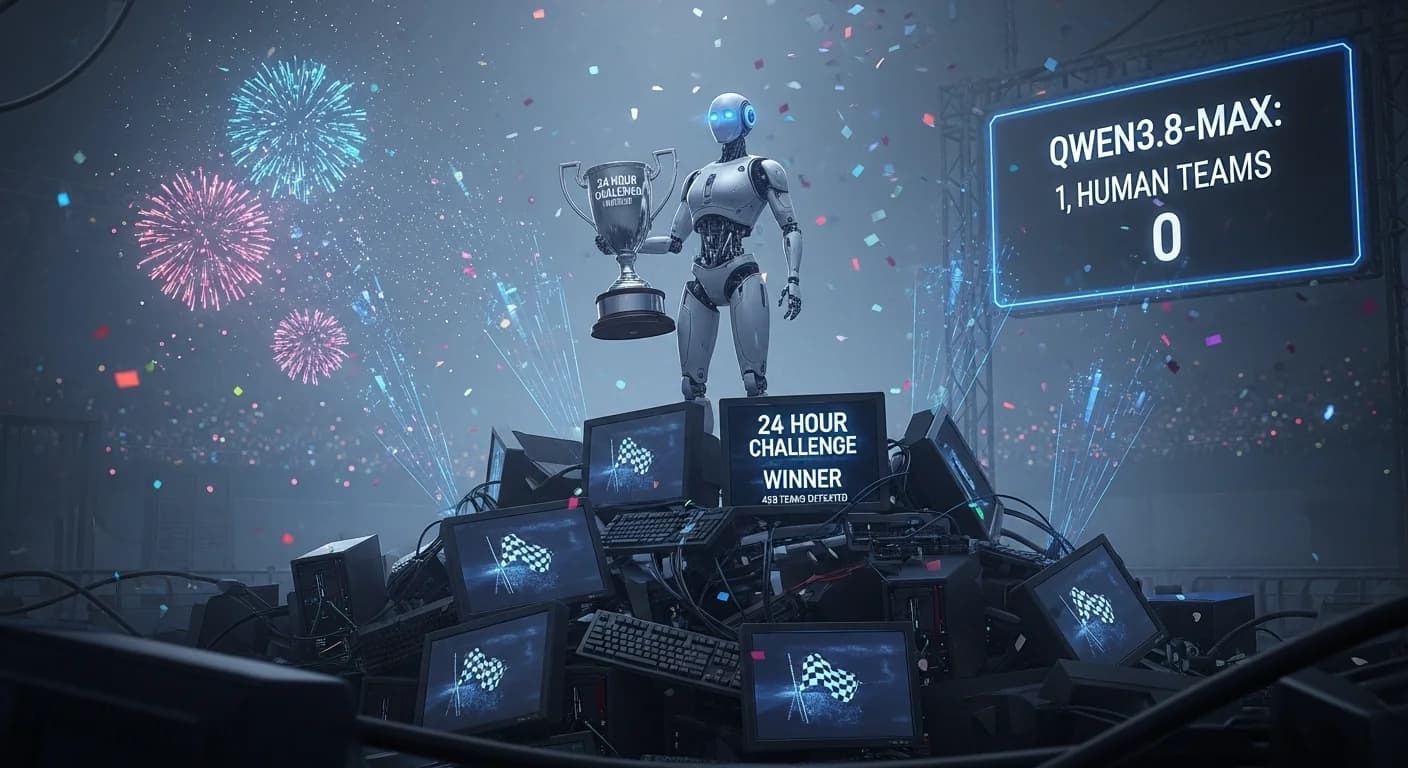
Alibaba's Qwen team released Qwen3.8-Max on August 2, a 2.4-trillion-parameter model it calls the most capable in the family. The open weights, a first for a Max-class model, are due next week. The release's real news is a set of claims about what the model did with no human watching: keep a software project running for over ten days, reproduce a research paper from scratch and then beat it, and finish ahead of most of a field of 526 human teams.
Those claims matter more than the usual benchmark table, because they describe sustained autonomous work, the kind that decides whether today's models are actually useful outside a demo. They are also, for now, entirely self-reported. Independent verification has not caught up. Keep that tension in mind through what follows.
Three runs with nobody watching
Qwen set the model three challenges, each lasting days and involving tool use, self-correction, and re-planning. The rules were similar in all three: the model started with no code and no human steer, and every result had to be earned by writing and running software.
| Task | Run length | Result, as reported by Qwen |
|---|---|---|
| Build the oh-my-cli project and a self-evolving harness | 10+ day run | 265 commits, 127 PRs, 151 issues after roughly 16 autonomous days |
| Reproduce a research paper, then improve on it | About 125 hours | 7,600 lines of code, 33 GPU training rounds, +2.7 points over the paper's method on AIME24 |
| Compete in a live contest against 526 human teams | 24 hours | 458 teams beaten (87%), accuracy from 0.60 to 0.853 |
The contest case is the one to read twice. The model read the competition rules, chose models to fine-tune (BERT, MacBERT, and RoBERTa for text, Qwen2.5-VL-7B for screenshots), and fused them into a weighted voting system. Each of its 45 submissions steered the next round of training, pushing accuracy from 0.60 to 0.853 and past 458 of the 526 human teams. The pattern the company is selling is not a single clever run. It is a loop that keeps improving itself, even if autonomous skill accumulation can also backfire.
Open weights change the stakes
Until now the Max tier was the closed part of the Qwen lineup. Qwen3.8-Max breaks that: the team says the weights will be published on Hugging Face and ModelScope next week, the first Qwen-Max-class open-weight release. At 95 billion active parameters out of 2.4 trillion, the open-source label now extends to a model designed for multi-day agent runs, not just chat.
The move fits Alibaba's broader strategy. The company consolidated its AI work into a single business unit with a mission, in its own words, to "create, deliver, and apply tokens," backed by a $53 billion investment push, and it has been shipping a fleet of models rather than a single champion. Qwen3.7-Max, released in May, was the previous flagship; independent benchmarking by Artificial Analysis showed it outperforming leading Chinese competitors and matching top global systems. Qwen3.8-Max is the next step on that path, with open weights as the differentiator, part of the quiet expansion of the Qwen3 family and a platform play rather than a model race.
The self-report problem
Nearly every number in the release comes from the team that built the model. Some benchmark rows for rival models are blank where no published score exists, and the harnesses used are not always identical from row to row. On the release's own featured table, Qwen3.8-Max's strongest entries against the named frontier rivals are PaperBench at 93.0, above the GPT-5.6 Sol score of 90.5, and 92.9 on the 8-needle variant of MRCR v2 at 256K context. Those are vendor numbers, but they are precise vendor numbers, in a field where static tests have largely collapsed as evidence.
The longest runs are the hardest to verify and the most striking. Given a stub workspace and an evaluation script, the model re-architected a cryptographic accelerator over roughly 500 turns, cutting the synthesized gate count from 8,298 to 678 and the placed die from 106 by 106 micrometers to 46 by 46, an 81 percent area drop, while closing timing at 500 MHz. The published milestones read like an engineer's log: replace the modulo divider, trim bitwidths, prune the state machine, merge modules, squeeze gates. In a 365-day simulated e-commerce benchmark built on Taobao and Tmall transaction data, it finished with a ¥416,252 balance, 38 percent ahead of the runner-up. The gap between public benchmark scores and this kind of long-horizon work is familiar from other contexts: top models clear 96 percent on SWE-bench Verified but barely 23 percent on private enterprise code.
A third-party run of a ten-day autonomous session, with the full trace published, is what would settle this class of claim. The Qwen team has done the next best thing in one case: the complete project history for the oh-my-cli build is public on GitHub, so every commit, pull request, and issue is checkable.
What ships with it
On the API side, Qwen3.8-Max supports a reasoning_effort parameter with three levels (xhigh, medium, low) and keeps thinking output preserved by default. It plugs into Claude Code, Codex, Qoder, Qwen Code, and OpenClaw through OpenAI-compatible and Anthropic-compatible endpoints, an integration list with roots in Qwen's own coding model work. A new library, Qwen-MM-Plugins, adds image and video processing to existing agent frameworks, and the team introduced RecreationBench, a benchmark for rebuilding real applications observed only as black boxes across five platforms.
The question for the next month is whether the autonomy holds up outside Qwen's own sandboxes. Independent labs get to answer that one. In the meantime, the release is significant for a simpler reason: Alibaba is betting that open weights, not just API access, are what it takes to put multi-day autonomous agents in front of the world.
Get the tech essentials in 3 minutes every morning
One email, every weekday, with what actually matters in AI and tech.