Local-language AI meets the Japanese enterprise
Sakana Namazu bets on keigo against the strongest AI era
Sakana AI introduced Namazu, a model specialized for Japanese business documents, email and keigo. It arrives as Asian enterprises report that scarce, low-quality local-language models are holding back AI adoption.
Emmanuel Fabrice Omgbwa Yasse AI-assisted
2026-08-03 · 4 min read
Japanese business email has its own grammar of respect. Polite forms, humble forms, verbs that shift depending on who outranks whom, and the right set of words to soften a rejection. Sakana AI's new model is built around that grammar.
Namazu, which the Tokyo firm positions as specialized for Japanese business contexts, handles business documents and email in natural Japanese, including keigo and the customs of corporate Japan. The company's pitch is blunt about the intended audience: "The more your work runs on Japanese, the more Sakana Namazu shines."
The gap Asian enterprises keep reporting
Namazu arrives against survey data that documents a mismatch. Alibaba Cloud Research, polling Asian enterprises about AI adoption, found support needs clustering around customized, industry-specific solutions (54%), availability of talent and skills (49%), and more accessible, affordable offerings (45%). Companies also called for successful case studies (42%), vendor-provided training (41%) and stronger board and management endorsement (32%).
The survey's findings, in brief:
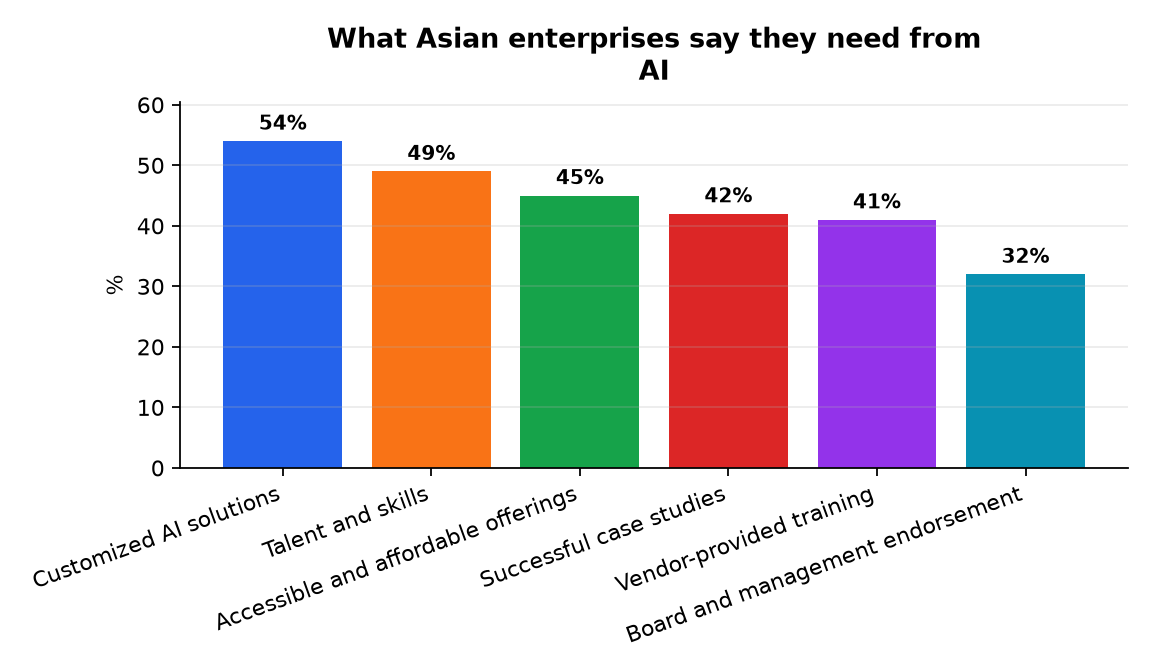
| What Asian enterprises say they need | Share of respondents |
|---|---|
| Customized AI solutions for industry use cases | 54% |
| More availability of talent and skills | 49% |
| More accessible, affordable offerings | 45% |
| Successful case studies | 42% |
| Vendor-provided training | 41% |
| Stronger board and management endorsement | 32% |
Read together, all six numbers say the same thing: enterprises want AI that fits their context, and language is part of that fit. The same mismatch shows up in the 957,253-record Messier corpus, where agents surge in coding but stall where enterprises need them, per the enterprise agent audit. In Japan, South Korea, Indonesia and Thailand, the problem is urgent. Enterprises there report that the scarcity of high-quality local-language models is holding back development, even as English- and Chinese-language models proliferate: Qwen3.8-Max alone beat 458 of 526 human teams in a 24-hour coding contest. Namazu is a direct answer to that complaint: a model built for one language, and one register of it.
Keigo is the moat
Keigo is the honorific layer of Japanese, the forms used toward clients, superiors and strangers. An email to a customer that gets it wrong reads as a breach of hierarchy, not a typo. Sakana's positioning, which leans on keigo and business customs as the model's selling points, implies this is where general-purpose models come up short.
The skill is learned on the job, in the way a request is phrased to a client, and it does not transfer across languages. The dominant play in AI today, as Sakana's head of product Sota Omura sees it, is polishing one supreme model and handing it to the whole world. The Chatbot Arena leaderboard, built on nearly five million blind human votes, is the scoreboard for that game. Namazu represents the opposite bet: that cultural coding beats raw capability in this market.
Namazu fits the ship-first playbook
The model is not Sakana's first release this cycle. Since March 2026 the firm has shipped four products in quick succession: Sakana Chat, Sakana Marlin, Sakana Fugu and Sakana Translate. Omura says the pace is deliberate, part of a bet against the 'strongest AI' era, the strategy he laid out in the rundown of Sakana's ship-fast cycle. Ship first, correct fast. Prototypes that once took months are finished in weeks.
Namazu fits that pattern: a narrow model for a narrow market, not an entry in an arms race. The wager is that usefulness beats supremacy when the customer writes in keigo.
The wider market is moving the same way
Sakana is not alone in treating Japanese output as a problem worth solving. MiniMax's Speech 2.8 makes quality Japanese synthesis from Chinese voices a headline fix, eliminating what the company describes as previous phoneme misalignment and unnatural intonation. Quality gaps that barely register in English are the difference between usable and useless in Japanese.
The Alibaba research adds a caution. Enterprises say a good model alone will not close the gap: they need vendor-provided training (41%) and stronger board and management endorsement (32%) to scale deployments. Namazu's real competition may be the cost of changing how Japanese companies buy software, not another model's benchmark score. That is a slower battle than any model release, and it may decide Namazu's fate.
Whether a keigo specialist is a durable moat or a feature that generalists eventually absorb is an open question. If the survey is right, part of the market is waiting for an answer. For now, Sakana has answered on its own terms: one language, done properly.
Get the tech essentials in 3 minutes every morning
One email, every weekday, with what actually matters in AI and tech.