Open Source Tools
30 GitHub repos that power the AI stack, from agents to local inference
A practical rundown of 30 essential GitHub repositories for AI developers, grouped by use case and ranked by community adoption.
Emmanuel Fabrice Omgbwa Yasse AI-assisted
2026-07-30 · Last updated: 2026-08-03 · 3 min read
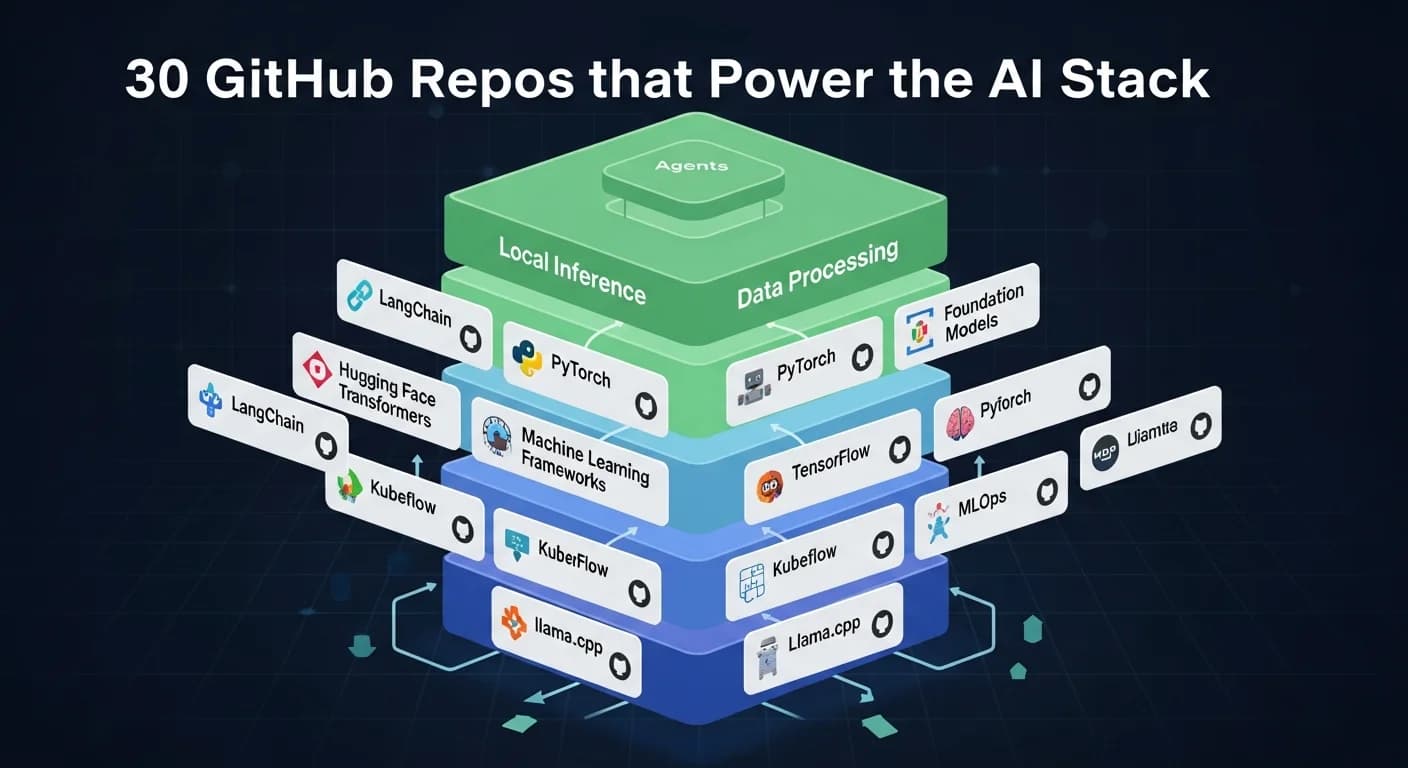
Anyone building with AI in 2026 has probably used a handful of these repositories. But unless you track the space daily, some will be new. A thread by developer @DivyanshT91162 gathered 30 GitHub repos spanning the entire AI stack, from agent orchestration to local inference and the glue that holds it together.
The collection skips the usual name-drops. It includes heavy hitters like LangChain, vLLM, and Transformers, along with focused tools such as Unsloth for faster fine-tuning, MLX for Apple Silicon, and Open WebUI as a self-hosted ChatGPT alternative. The lineup shows where open-source AI is heading: modular, developer-obsessed, and increasingly capable on a laptop.
Agent frameworks and orchestration
Agents take up the biggest share. LangChain and LangGraph dominate for building LLM workflows and stateful agents. Microsoft's AutoGen and CrewAI both handle multi-agent coordination, but differently: AutoGen uses conversational patterns, CrewAI uses role-based teams. OpenHands and Bolt.diy push further, aiming to automate entire software engineering workflows. n8n and Flowise offer visual interfaces for stitching AI into automation, while Dify provides a full app platform with RAG and model management. The orchestration space is moving fast, and design choices matter for safety and scaling orchestration beats raw size, and a disrupt-validate-broker approach could redefine how agents handle risk.
LLM inference and local deployment
Running models is a different problem from building agents. vLLM is the standard for high-performance GPU inference in production. Ollama brings that ease to local machines: one command, running Llama, Qwen, or Mistral on a laptop. LiteLLM abstracts provider APIs so you can switch between OpenAI, Anthropic, and local models with one interface. Open WebUI wraps Ollama in a ChatGPT-like interface you host yourself, and AnythingLLM adds RAG for private document search and chat. Hardware strategy and cost control are increasingly central to inference decisions four distinct infrastructure strategies and cheaper old-GPU models can match frontier performance.
Vector databases: the memory layer
Almost every RAG stack needs a vector store. Five databases appear in this list, each with a different tradeoff:
| Repository | What it does | Best for |
|---|---|---|
| Chroma | Embedding database, lightweight | Getting started, embedded apps |
| Qdrant | High-performance vector search | Production services, filtering |
| Milvus | Scalable, cloud-native vector DB | Large-scale deployments |
| Weaviate | AI-native, hybrid search supported | Applications needing both vector and keyword |
| FAISS | Meta's fast similarity search | Embedded recall, batch indexing |
Choosing one depends on scale and desired infrastructure overhead. Chroma and FAISS are good for prototyping and embedded use; Qdrant and Milvus handle production loads with replication and sharding. Weaviate sits in the middle with built-in hybrid search.
Fine-tuning, specialized models, and the rest
The list rounds out with tools for fine-tuning and specific domains. Unsloth speeds up LoRA and QLoRA training, often halving GPU memory use. Hugging Face's Transformers remains the go-to library for running almost any model. Whisper handles speech-to-text across languages, ComfyUI gives node-based control over Stable Diffusion pipelines, and MLX is Apple's framework for on-device training and inference. FastAPI and Supabase appear too: not AI-specific, but the backend scaffolding many AI services rely on.
The thread also includes OpenAI Cookbook (production patterns), LlamaIndex (data-to-LLM connectors), Continue (open-source coding assistant for VS Code), Haystack (search and RAG framework), and n8n (already mentioned).
Save that thread. You will keep returning to it.
Get the tech essentials in 3 minutes every morning
One email, every weekday, with what actually matters in AI and tech.