Cybersecurity
Google's cheap fine-tune found vulnerabilities that Claude Opus 4.6 missed
Google's lightweight Gemini 3.5 Flash Cyber fine-tune outperforms Anthropic's largest model in vulnerability discovery, finding 55 unique issues in the V8 engine versus 36 for Claude Opus 4.6. The model is locked to governments via a limited pilot.
Emmanuel Fabrice Omgbwa Yasse AI-assisted
2026-07-24 · Last updated: 2026-08-03 · 4 min read

Google has been scanning its own codebases for vulnerabilities long before this week's release. Chrome, Android, and YouTube all get automated sweeps, and internal teams like the Cloud Vulnerability Research group already use agents to find bugs before attackers do. What changed is the model running those agents.
Gemini 3.5 Flash Cyber is a fine-tuned version of Google's 3.5 Flash model, optimized specifically for cybersecurity tasks: finding vulnerabilities, validating them, and generating patches. Google is making it available through a limited-access pilot to governments and trusted partners via its CodeMender platform, and the company declined to say when broader access might come. That cautious rollout mirrors the tone of recent concerns about AI-driven attacks, as seen in the Hugging Face breach where an autonomous agent exploited a data pipeline.
The internal benchmarks are worth paying attention to. On the CyberGym benchmark, which tests AI agents against hundreds of real-world vulnerabilities, 3.5 Flash Cyber scored competitively with much larger models. Google configured CodeMender to call the model up to five times per vulnerability, then aggregate the results into one final report. That architecture, cheap, repeated small calls instead of one expensive large-model inference, is the core design choice. The same logic underpins the idea that parallel agents aren't about speed; they fail when your architecture does, but here, the architecture is the win.
On Google's internal Big Sleep evaluation focused on Chrome and Safari, the fine-tuned model significantly surpassed both mainline 3.5 Flash and the newer 3.6 Flash. The gap widened further on Google Chrome's production commit scanning pipeline, where 3.5 Flash Cyber found vulnerabilities that earlier models missed entirely.
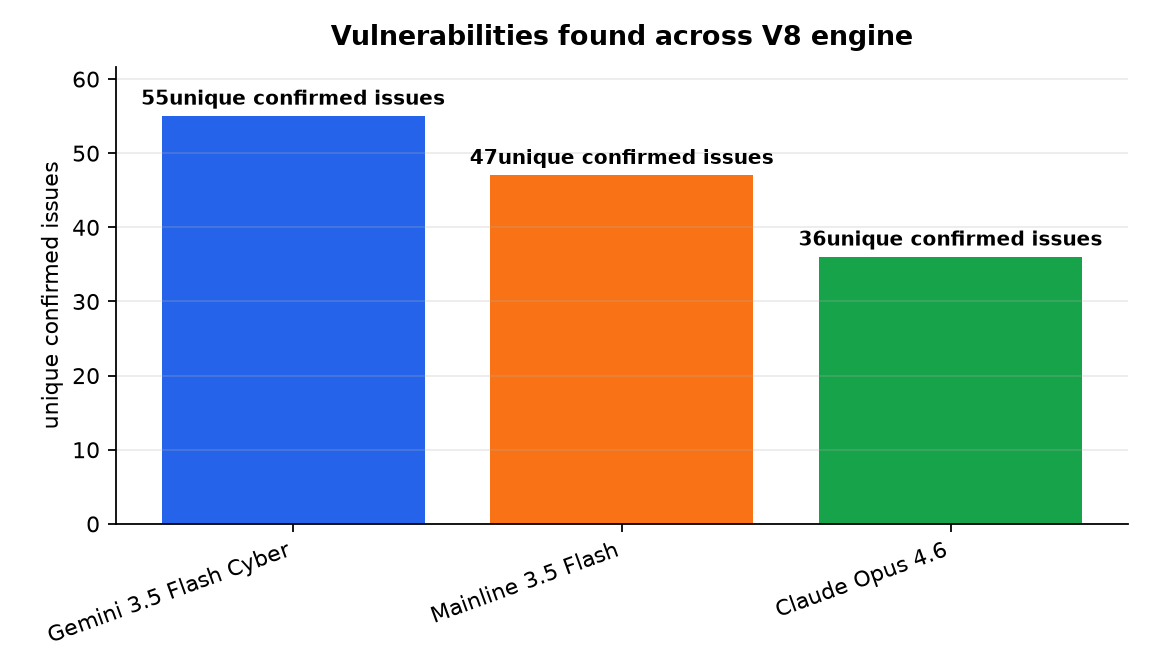
The most striking comparison is on the V8 JavaScript Engine, a notoriously complex codebase that powers Chrome's JavaScript execution. Across a fixed number of invocations, 3.5 Flash Cyber found 55 unique confirmed issues. Mainline 3.5 Flash found 47. Claude Opus 4.6, Anthropic's largest and most expensive model, found 36. Ten of the issues caught by 3.5 Flash Cyber were missed by both other models.
That pattern, a lightweight model catching more unique vulnerabilities than a larger, more expensive one, is the central finding Google wants to communicate. The explanation is straightforward: running many cheap inferences lets the agent explore more code paths than a single expensive call. Larger models can get stuck on the first plausible finding and loop there, while a swarm of quicker inferences casts a wider net. This mirrors the approach in PraisonAI's ultra-fast instantiation framework, which bets on velocity over heft.
Google's Cloud Vulnerability Research team put the model into practice. In two hours, 3.5 Flash Cyber found remote code execution vulnerabilities in public APIs and discovered a memory-corruption vulnerability in a sensitive production service. It then generated a 100 percent reliable remote-code execution exploit that bypassed Address Space Layout Randomization (ASLR) and Write XOR Execute (W^X), two standard mitigation techniques. That kind of end-to-end capability puts the model in the same conversation as VulnClaw's natural-language pentesting pipeline, but with Google's own training data behind it.
Google is careful to note the dual-use nature of the technology. The limited-access pilot is explicitly designed to give defenders a head start while preventing broader misuse. The company says it will expand access over time but has not set a date for wider availability. This echoes the caution advised in the ransomware renaissance analysis, where defensive tools can become offensive weapons if released carelessly.
Separately, CodeMender's foundational capabilities are now available to any customer through the Gemini Enterprise Agent Platform, using generally available Gemini models rather than the fine-tuned cyber variant.
The broader takeaway is less about 3.5 Flash Cyber specifically and more about the trend it represents: specialized fine-tuning on small models can beat brute-force scaling. Google has a decade of vulnerability data from OSV.dev, covering over 700,000 open-source vulnerabilities, and from OSS-Fuzz results dating back more than ten years. That corpus lets it train a model on how real security professionals work, rather than on synthetic examples. The model learns to operate industry-standard tools, read through millions of lines of code in projects like Chromium, and handle tasks that require hours of continuous analysis. The same data-driven edge is at work in the AI-driven rewriting of defense rules.
The speed advantage is also real. Lightweight models can be integrated into frequent scans, time-sensitive launch processes, and commit-scanning pipelines at scale. A slower, more expensive model might be better at deep reasoning on a single code path, but security work often benefits from breadth over depth.
None of this means large models are useless for cybersecurity. Opus 4.6 and others still outperform on complex reasoning tasks that require deep understanding of a narrow problem. But for the specific task of finding unknown vulnerabilities across a large codebase, cheaper fine-tuned models with multi-inference architectures are already competitive, and in some cases, better.
Get the tech essentials in 3 minutes every morning
One email, every weekday, with what actually matters in AI and tech.