AI Research
A 4.5 point score jump on MATH-500 from a monitoring controller that catches wandering models
New research proposes an external monitoring controller for quantized small language models that detects repetitive or degenerating reasoning paths and triggers a rollback and constrained re-decoding. Accuracy improved by 4.5 percentage points on a broad evaluation set, but the authors stress the findings are not confirmatory.
Emmanuel Fabrice Omgbwa Yasse AI-assisted
2026-07-30 · Last updated: 2026-08-03 · 3 min read

Quantized small language models save memory and inference cost, but they also tend to wander, producing long, repetitive, or otherwise unproductive chains of reasoning without any built-in mechanism to notice. A new preprint from El Hassane Ettifouri, posted to arXiv on July 22, 2026, targets this blind spot with a lightweight external controller called MGT-B (Monitoring-Guided Test-time Backtracking).
MGT-B builds on an earlier token-level e-CUSUM controller. It monitors overlapping windows of pre-sampling uncertainty and degeneration features, maps them to empirical tail probabilities, and accumulates a betting factor with a CUSUM-shaped reset. When an alarm triggers, the controller estimates a rollback point, restores the token and key-value-cache state, and runs a constrained re-decoding from that position.
The key question is whether such a mechanism improves accuracy. The paper reports two analyses. A chronology-audit set of 240 problem pairs, designed to exclude any data that might have influenced the manual choice of the log threshold h = 10, showed accuracy move from 82/240 to 88/240, a gain of 2.5 percentage points. The exact McNemar p-value was 0.2632, meaning the result is not statistically significant at conventional levels.
A broader historical-coverage set of 467 seed-matched pairs showed a more pronounced shift: from 146/467 to 167/467, or plus 4.5 percentage points, with a McNemar p-value of 0.000753. But the authors are frank about the limitations. That set includes 200 seed-1 IDs that were available during or before the threshold was chosen, so the analysis is reported only as exploratory, not confirmatory. For similar efficiency gains in inference, see how speculative decoding hides latency without changing outputs, as covered in speculative decoding analysis.
Selective corrections, no regressions on no-alarm paths
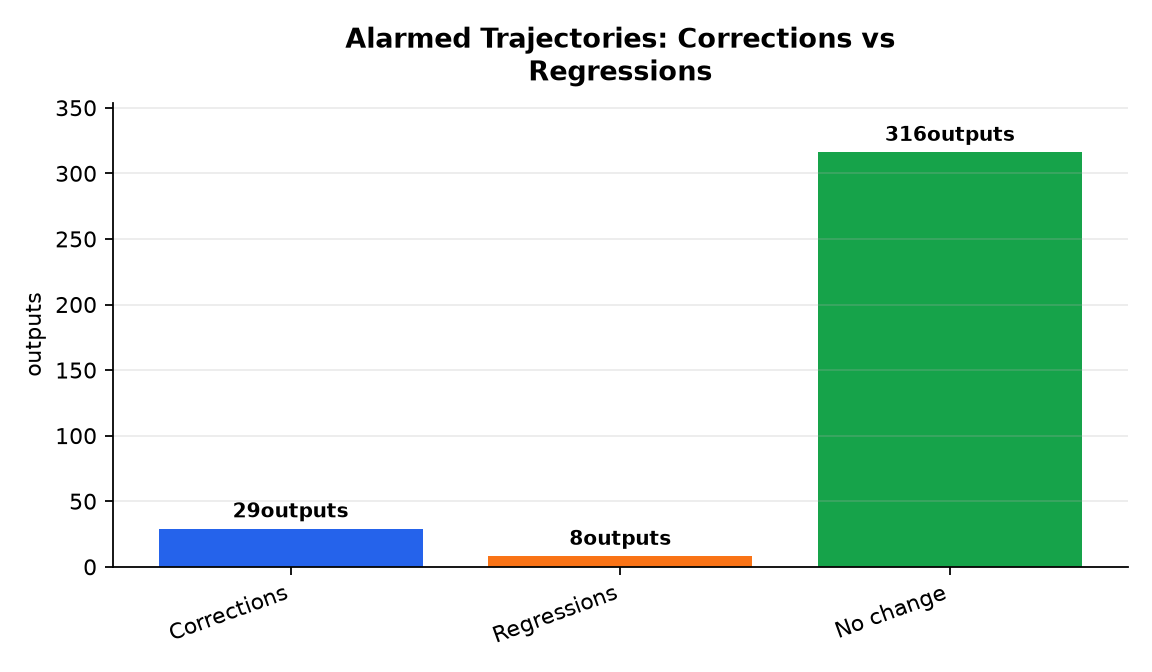
One clean signal in the data: all 316 outputs in the 467-pair set that triggered no alarm were identical to the vanilla baseline. The 151 alarmed trajectories contained 29 corrections and 8 regressions, meaning the controller helps more often than it hurts, but not universally. This selective intervention mirrors challenges seen in multi-agent coordination: see the group chat as proving ground.
The paper is careful to disclaim any broad theoretical guarantee. The results support a selective monitoring-and-repair mechanism for the specific MATH-500 setting studied, not a general method for improving small-model reasoning. The authors also note that the empirical factors used by MGT-B are not established as a valid e-process or e-detector; the paper is an empirical prototype, not a formal statistical framework. For context on how verification remains a hard problem even in larger systems, see the verification horizon analysis.
A targeted tool, not a silver bullet
For practitioners working with quantized small models on math reasoning benchmarks, MGT-B offers a concrete, lightweight add-on that appears to correct more errors than it introduces. But the effect size is modest, the evaluation is small, and the authors do not claim the method transfers to other domains or model sizes. The broader lesson about the limits of inference-time fixes is part of why model routing is more a systems problem than a classification one, as discussed in the model routing analysis.
The preprint is best read as a demonstration that inference-time monitoring and rollback can work in a narrow setting, with the caveats fully acknowledged. It does not challenge the broader conclusion that reward and verification signals remain a hard problem in AI; it adds a specific, bounded technique to the toolbox, not a general solution. For another example of how small models can compete efficiently, see how a 33B model beat 137B models on coding benchmarks in this Poolside update.
Get the tech essentials in 3 minutes every morning
One email, every weekday, with what actually matters in AI and tech.