Network Autonomy
AgentToolMO fixes a trust blind spot in multi-vendor agent networks
When Vendor B's tool is compromised, Vendor A's agents keep using it unaware. A new paper proposes a trust state machine with damped cascade propagation to bring containment from hours to near real-time.
Emmanuel Fabrice Omgbwa Yasse AI-assisted
2026-08-04 · 2 min read
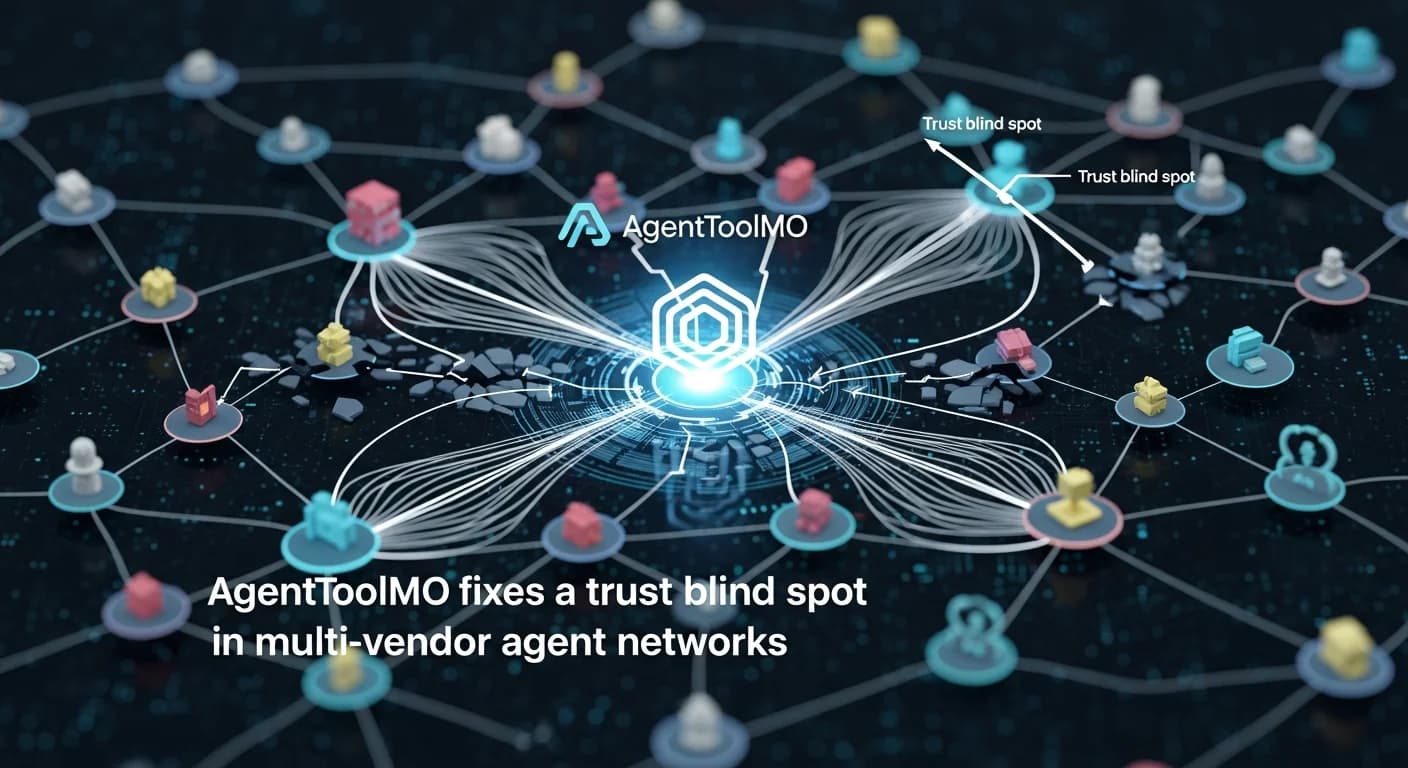
Here's the core issue: autonomous agents from different vendors cannot see each other's tool trust status. If Vendor B's tool is compromised, Vendor A's agents keep invoking it, unaware. The result is cascading service impact that can propagate for hours before anyone detects it.
A research paper posted to arXiv on July 28 proposes AgentToolMO, a standardized trust management model for agent tools. It fits inside the 3GPP Network Resource Model framework. The model uses a formally defined trust state machine with graduated enforcement, damped cascade propagation that guarantees bounded convergence, and cross-vendor trust notifications sent over existing Management Services (MnS) interfaces.
This isn't hypothetical. As autonomous networks aim for Level 4 and Level 5 operations, AI agents must call tools across vendor boundaries without human oversight. Current management standards have no cross-vendor trust visibility. The paper's simulations show that standardized notifications reduce the blast radius from "hours-scale undetected propagation" to near-real-time containment, bounded only by MnS delivery latency. Cascade convergence is guaranteed in a bounded number of iterations, and notification volume scales sub-linearly as vendor domains grow, a coordination pattern familiar from multi-agent systems parallel agent orchestration.
The trust visibility problem echoes broader issues in agent deployment. A recent tutorial flagged robustness, safety, and reliability as open problems in multi-agent coordination routing to multiple models. Another paper on dynamic capability scoping argued that static credential sets increase the attack surface. The same principle applies here: a compromised tool's trust state must be visible and enforced across vendors in near real-time, not left to static configuration.
AgentToolMO also includes retroactive impact assessment: it traverses the NRM dependency graph so operators can see which agents were hit after a trust degradation. Because it works within existing 3GPP infrastructure and protocols, it has a clear path to standardization. But real-world deployment of any agent system comes with its own pitfalls the planning trap analysis.
For now, the paper is on arXiv. Real deployment would require adoption by standards bodies like 3GPP, a question that extends to who controls the infrastructure beneath open multi-vendor orchestration who controls AI infrastructure.
- Source : A trust blind spot in multi-vendor agent networks gets a fix — 2026-07-28
Get the tech essentials in 3 minutes every morning
One email, every weekday, with what actually matters in AI and tech.