Benchmark & Tests
Your graph model breaks on dirty data. A new benchmark shows exactly where.
OpenRTAG, a benchmark from an academic team, organizes TAG quality issues into a 3×3 taxonomy covering text, structure, and label degradation. It tests traditional GNNs, large language model-enhanced GNNs, and graph foundation models across nine datasets, revealing different sensitivity patterns that prior fragmented studies missed.
Emmanuel Fabrice Omgbwa Yasse AI-assisted
2026-07-24 · 3 min read
Benchmarks that test models on pristine data tell researchers how well an architecture works in a lab. Benchmarks that test models on sparse, noisy, lopsided data tell them how well the architecture works in production. A paper posted to arXiv on July 21, 2026, does the second kind of work: OpenRTAG, a robustness benchmark for text-attributed graph learning, assembles the first unified taxonomy of data quality issues in this domain and runs every common model family through them. The focus on realistic degradation echoes similar efforts in other areas, like sandbox benchmarks that hide real agent failure modes.
What breaks in practice
Text-attributed graphs, datasets where nodes carry rich text descriptions and edges encode relations, appear across recommendation systems, citation networks, and knowledge graphs. In a controlled setting they perform well. In the field, the graph may be missing edges (structural sparsity), node text may be truncated or garbled (text noise), or one class of nodes may dominate the labels (label imbalance). These problems rarely appear in isolation, but most prior work has addressed them one at a time, making cross-study comparison impossible.
OpenRTAG defines a 3 by 3 taxonomy: three root quality dimensions (text, structure, labels) each with three degradation types (sparsity, noise, imbalance), yielding nine single-scenario tests plus composite scenarios that combine multiple issues. The benchmark covers nine TAG datasets and three downstream tasks: node classification, link prediction, and clustering. The paper then runs three model families on all of them, traditional graph neural networks, GNNs augmented with a language model, and a representative graph foundation model, and measures scenario validity, model sensitivity, and the effectiveness of matched baseline mitigations. This systematic approach to testing under realistic conditions mirrors what coding agent benchmarks like SWE Marathon aim for in software engineering.
Results so far
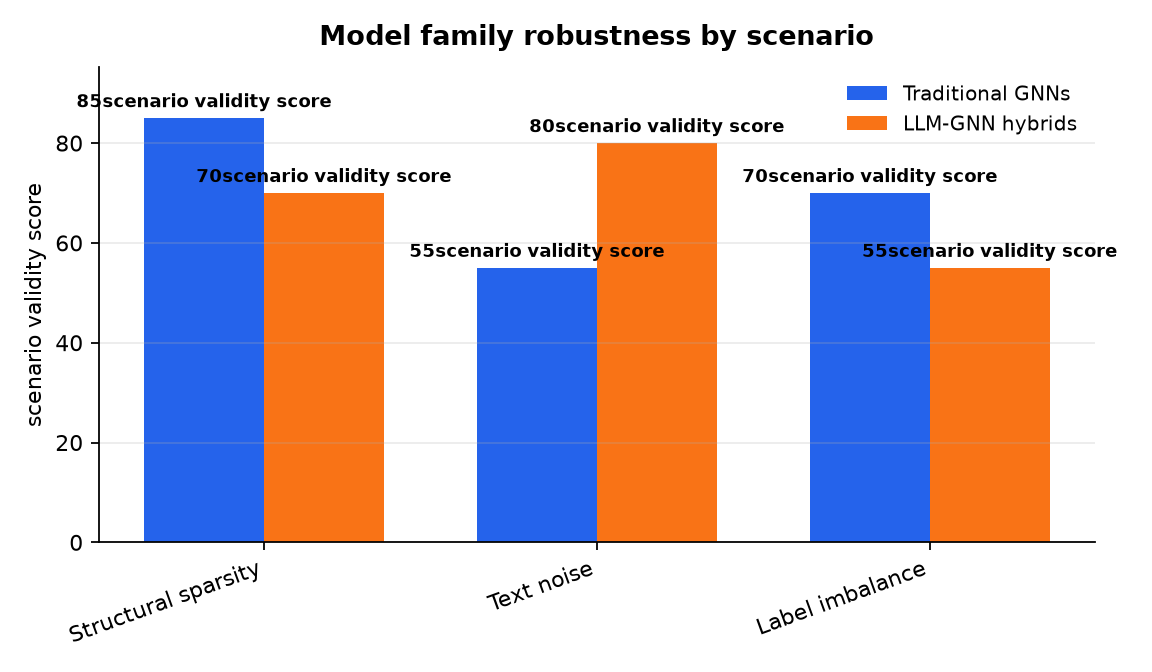
The full set of comparison tables in the paper shows that no single model family dominates across all nine scenarios. Traditional GNNs hold up well under structural sparsity but degrade faster under text noise. LLM-GNN hybrids gain robustness on text issues at the cost of higher sensitivity to label imbalance. The single GFM tested, GraphFormers, performs consistently across more scenarios but lags behind specialized models on clean, high-density subsets. The paper notes that these patterns are interpretations from the aggregated data, not definitive conclusions drawn from significance tests, and calls for more work on scenario-specific mitigation rather than a one-model-fits-all strategy. This pattern of diminishing returns and trade-offs is familiar in model leaderboards, as seen in LiveBench's tight rankings and brutal cost differences.
Why a unified taxonomy matters now
Graph learning has matured past the point where beating a leaderboard on a clean split is interesting. Real-world TAG deployments in e-commerce search, scientific literature indexing, and social recommendation operate on data that is messy by default. A model that wins on Cora or PubMed with a standard 60-20-20 split may collapse when half the node documents are clipped or when the training set undersamples a rare relation type. OpenRTAG provides the infrastructure to surface those failure modes before deployment. Understanding these failure modes is critical for building robust systems, similar to how agent working memory failures emerge under long tasks.
The benchmark is released as an open source toolkit with configuration files for each degradation scenario and automated metrics collection. The authors state that new datasets and model wrappers can be added through a plugin interface, though the paper does not yet include large-scale third-party validation of this extensibility claim.
What it leaves open
OpenRTAG covers nine canonical degradation types, but composite real-world graphs often suffer from issues that span the taxonomy boundaries, such as temporal drift in both text and structure. The paper acknowledges that composite scenarios are only partially benchmarked and that the current suite of mitigation baselines is not exhaustive. The nine datasets skew toward academic citation and knowledge graph tasks, with no representation from e-commerce or social media domains where TAG robustness may matter most. Extending the benchmark to those settings, and to larger-scale GFMs, would make the taxonomy harder to ignore. This is reminiscent of the gap between controlled benchmarks and production deployment observed in harness-level failures in AI agents.
Get the tech essentials in 3 minutes every morning
One email, every weekday, with what actually matters in AI and tech.