Inference Endpoints v2
Hugging Face isn't fighting the model war. It's making deployment boring.
Hugging Face revamps its Inference Endpoints service, emphasizing ease of deployment over raw model performance. The platform now supports vLLM, SGLang, llama.cpp, and custom containers, with autoscaling and pay-as-you-go pricing. The pitch: skip the ops work and focus on the model.
Emmanuel Fabrice Omgbwa Yasse AI-assisted
2026-07-24 · 5 min read
Hugging Face has spent years building the default repository for open models. You can browse nearly any transformer architecture, read its paper, check its leaderboard score, and download the weights in seconds. The part that has stayed hard is what happens after you download them.
Getting a model into production reliably, with autoscaling, monitoring, and a proper API, has meant owning a cloud bill and knowing enough Kubernetes to be dangerous. The Inference Endpoints service has existed since 2022, but the platform team has quietly been filling in the gaps that kept it from being a default choice rather than a fallback.
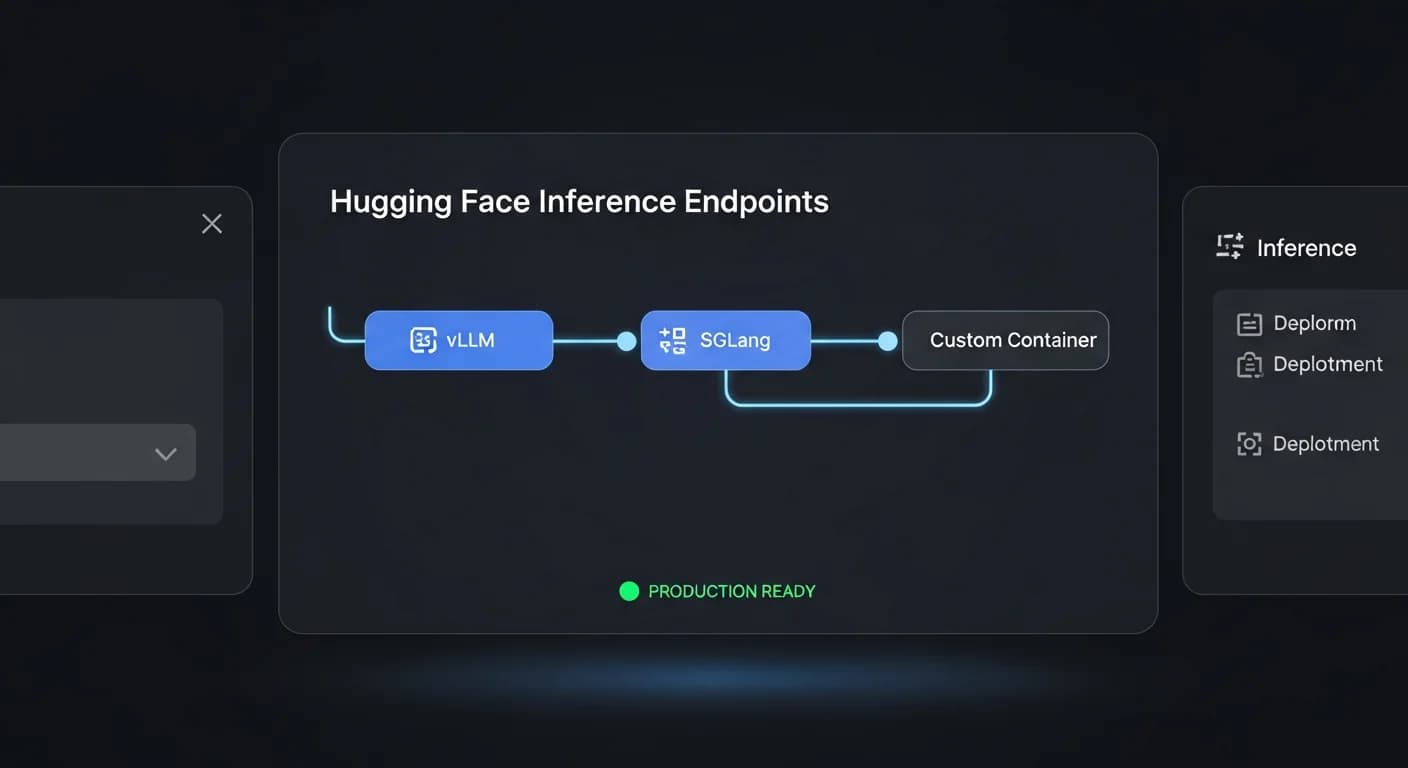
The core offer now is a managed inference layer where you pick the model, the framework (vLLM, SGLang, llama.cpp, TGI, TEI, or a custom container), and the endpoint type, and the platform handles the rest. Autoscaling is built in, observability comes with logs and metrics, and the pricing is consumption-based with no upfront commitment. The company frames it as "focus on your model, not the ops." For teams selling the productivity promise to internal stakeholders, see Google's own take on the productivity gap.
What changed
The most material shift is the breadth of framework support. Early versions of Inference Endpoints were tightly coupled to Hugging Face's own Text Generation Inference (TGI) and Text Embeddings Inference (TEI) containers. Those are still first-class citizens, but the platform now runs vLLM, SGLang, and llama.cpp directly, which means a team already optimized on one of those can deploy without reimplementing their pipeline.
Custom containers open the door further. If your model needs a specialized inference loop, or you have custom preprocessing logic that doesn't fit a standard framework, you can bring your own Docker image. The infrastructure layer is abstracted to the point where the endpoint definition can be a single hf CLI command, or a prompt to a coding agent that invokes the CLI.
"Don't worry about Kubernetes, CUDA versions, or configuring VPNs," the platform copy reads. For teams that are model-first and ops-light, that reduction is the value proposition.
Who is already using it
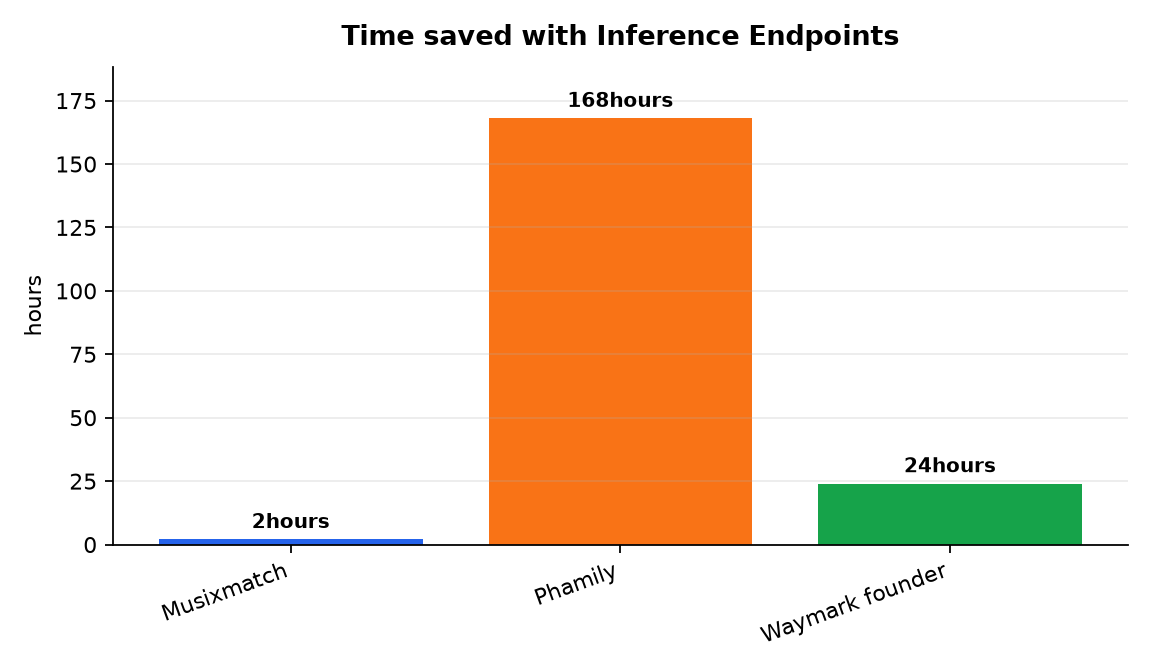
Hugging Face lists several production users. Musixmatch, the lyrics platform, used Inference Endpoints to deploy a custom interface, with data scientist Andrea Boscarino saying the adaptation took "a couple of hours." Phamily, a healthcare startup, claimed the service saved a week of developer time, with senior engineer Bryce Harlan noting the team now spends all its time on R&D rather than AWS configuration. The Phamily case lines up with broader findings in prompt engineering guides for professionals.
Pinecone deployed a model handling over 100 requests per second. Gareth Jones, a senior product manager there, said the deployment took "just a few button clicks." Waymark founder Nathan Labenz said the platform collapses the time from testing to production to potentially less than a day.
None of these are edge cases: they cover content extraction, healthcare, vector search, and ad tech. That range suggests the abstraction holds across different workload shapes, which is what a managed service needs to prove.
The competitive landscape
Inference Endpoints sits between two product categories. On one side are raw cloud providers, AWS SageMaker, GCP Vertex AI, Azure ML, which give you control but demand expertise. On the other side are model-as-a-service APIs like OpenAI, Anthropic, and Google, which abstract everything but lock you into a specific model family behind a proprietary API.
Hugging Face's bet is that there is a growing middle: teams that want to choose their own model, including open ones, without building their own deployment stack. If that middle is real, the moat is the Hub, the catalog of 900,000+ models that already has versioning, metadata, and a download API. Inference Endpoints plugs directly into that catalog. The approach echoes how Sakana AI's Fugu-Cyber advises: leverage ecosystems rather than monolithic tools.
"Download model weights fast and securely with seamless Hugging Face Hub integration" is not just a feature, it is the core architectural advantage. No other inference platform can claim that integration because no other platform is the model hub.
What is not said
The service page does not mention pricing tiers or specific GPU types. It says "pay-as-you-go pricing" and encourages enterprises to request custom quotes. That opacity is common in managed GPU services, where real costs depend on workload characteristics, but it makes a direct cost comparison against API-based providers or raw cloud instances difficult without signing up.
The page also does not address cold-start latency, a known pain point for autoscaling inference services. Models can take tens of seconds to load on first request, depending on size, and a fully managed service has incentives to underprovision idle replicas to save cost. How the platform balances those trade-offs is not described. For a deeper dive into similar infrastructure trade-offs, see the math behind speculative decoding.
What it means
Hugging Face is not competing on model quality. It is competing on the friction between a model download and a production API. The platform team has identified that the deployment step is where most open-model projects stall, and Inference Endpoints is the lever they are pulling to unstick it.
Whether that lever is strong enough depends on how many teams are actually willing to pay a managed provider a premium over raw cloud compute, versus running their own vLLM stack on a single GPU instance. But for teams that have weighed the tradeoff and chosen the managed path, Hugging Face now has a credible answer. The broader question of which AI tools justify their cost is explored in the LiveBench leaderboard analysis.
Get the tech essentials in 3 minutes every morning
One email, every weekday, with what actually matters in AI and tech.