Practitioner guide
LangGraph is not an AI benchmark. It's a process framework that knows when to say no.
A practitioner guide on arXiv argues LangGraph fits specific workflow complexity tiers, not every AI use case. Three executable recipes, SQL analytics with repair loops, agentic RAG with evidence gating, and human-in-the-loop policy review, illustrate where the extra structure pays off and where simpler alternatives suffice. With runnable code and clear carve-outs for overkill scenarios.
Emmanuel Fabrice Omgbwa Yasse AI-assisted
2026-07-24 · Last updated: 2026-08-03 · 4 min read
Not every AI system needs a state graph, and a paper posted to arXiv on July 21 makes the case that knowing when not to use one is just as important as knowing how to wire one up.
"Graph-Based Agentic AI with LangGraph: Workflow Pathways for Long-Running Stateful Business Processes" treats the orchestration framework as a practitioner tool for specific workflow-complexity tiers, not as a universal default or a benchmark target. The authors walk through three executable recipes, SQL analytics with self-repair loops, agentic retrieval-augmented generation with evidence gating, and human-in-the-loop policy review with interrupt and checkpoint recovery, to show how typed state, conditional routing, deterministic tools, retries, interrupts, checkpoints, and traces fit together in production code.
The paper comes with a full ancillary-code repository: roughly two dozen source files including test suites, a mock database, and configuration, so the patterns are testable rather than abstract. The authors license it for reuse. See also the contrast with ultra-fast instantiations from other frameworks.
The preprint explicitly carves out scenarios where LangGraph is overkill. Simpler ReAct-style loops or plain SDK calls may serve basic tool use better. Schema-first tools handle structured extraction and validation more cleanly. DSPy is a stronger pick when the main goal is prompt or program optimization. LangGraph, in this view, earns its complexity only when a process needs typed state persistence, conditional routing across multiple steps, interrupt handling, checkpoint recovery, and explicit trace-driven audit trails. A related benchmark of agent harnesses reinforces that model quality alone seldom predicts workflow reliability: see PawBench's findings on harness versus model failure modes.
That positioning aligns with a broader shift as agents move from research demos into business workflows. A related arXiv paper from June, "Agents in the Wild: Where Research Meets Deployment," maps the gap between controlled-agent evaluations and the messier constraints of production environments, latency budgets, error recovery, human oversight, that frameworks like LangGraph try to formalize. For a deeper look at how working memory constraints affect multi-step agents, StructAgent research on state-centered architectures offers complementary evidence.
The three recipes illustrate that formalization differently. The SQL analytics workflow includes a repair loop: when a generated query fails on the database, the agent inspects the error and retries with corrected syntax, capped at a configurable maximum. The agentic RAG recipe gates its evidence on three tiers, does the retrieved document exist, does it answer the question, and does it cite a verifiable source, before passing a result to the user. The human-in-the-loop policy-review workflow pauses execution at a designated checkpoint, waits for a human decision, and resumes from that exact state rather than restarting.
Each recipe exposes state explicitly through the graph's nodes and edges rather than hiding it inside prompt instructions. That is the core design argument the paper makes: audit trails, routing rules, and pause points become inspectable code paths rather than opaque LLM output. A supporting architectural perspective from tool hierarchy research shows how flat registries break at scale: the 96% context cut that finally makes AI agent tool hierarchies work.
Where the framework fits
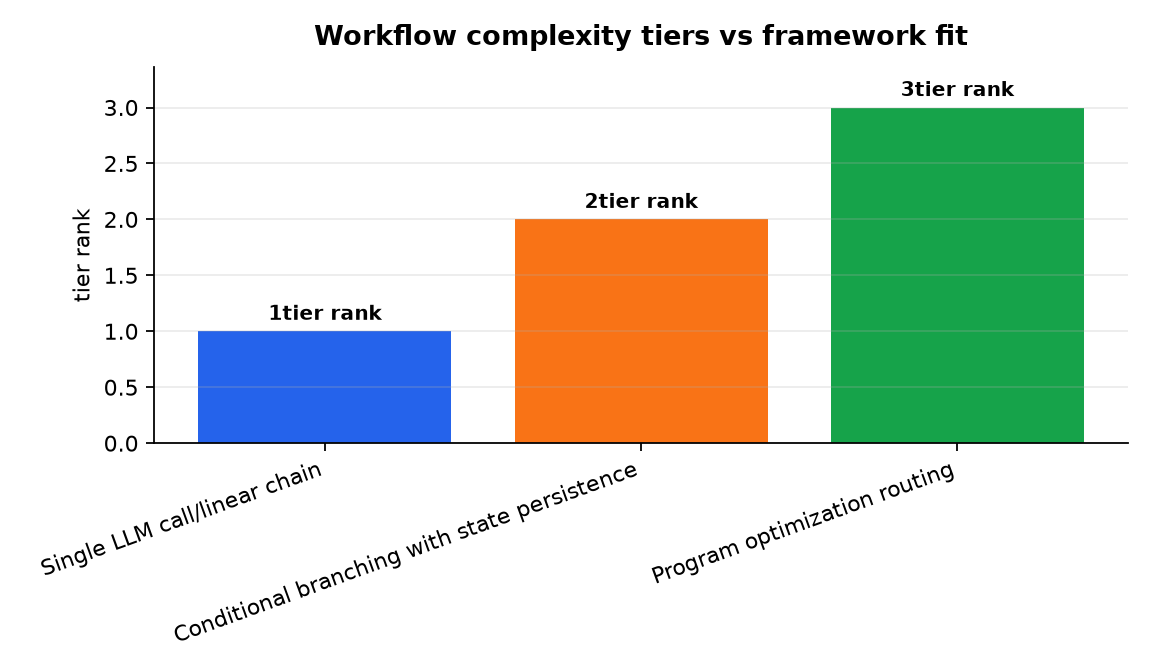
The paper's contribution is less about LangGraph itself and more about the decision framework for choosing it. The authors provide a simple triage: if a workflow fits in a single LLM call or a linear tool chain, stop there. If it needs conditional branching with state that persists across turns, LangGraph becomes worth the overhead. If the complexity comes from program optimization rather than routing, DSPy is a better fit. For teams building pipelines from scratch, read the guide on pipeline design where model selection matters less than orchestration.
This kind of pragmatic framing is useful as the agent-tooling ecosystem grows. A July 2026 paper from Microsoft describes a platform that lets scientists define agentic workflows as directed graphs where each node can be an AI model, a data transformation, or a human approval step. The conceptual overlap is clear, graphs as the organizing metaphor for multi-step agent systems, but the LangGraph paper stays narrower and more opinionated about when the graph abstraction justifies itself. Recent work on parallel agents reinforces this opinion: concurrency fails where architecture does not match workflow complexity.
Code as the argument
The ancillary files include a mock LLM client, a set of YAML prompt templates, SQLite database fixtures, and test coverage. That makes the paper more like a technical report with runnable validation than a position essay. The authors commit to a specific view of how state should flow through an agent, via LangGraph's typed State objects passed explicitly between nodes, and the code backs up every design choice with a working example.
For teams evaluating orchestration frameworks, the paper offers a concrete starting point: clone the repo, run the three workflows, and decide whether the structure clarifies or complicates their own use case. That question, not any benchmark score, is the metric the paper proposes.
Get the tech essentials in 3 minutes every morning
One email, every weekday, with what actually matters in AI and tech.