AR & Wearables
Two dials made Viture's $299.99 Pro 2 the sharpest AR glasses yet
The Verge called Viture's $299.99 Pro 2 the sharpest AR glasses it has seen, thanks to diopter dials that beat the usual $50 prescription-insert workaround. Here's what the price gives up, and why it lands in the range where AR sales are forecast to take off.
Emmanuel Fabrice Omgbwa Yasse AI-assisted
2026-08-09 · 4 min read
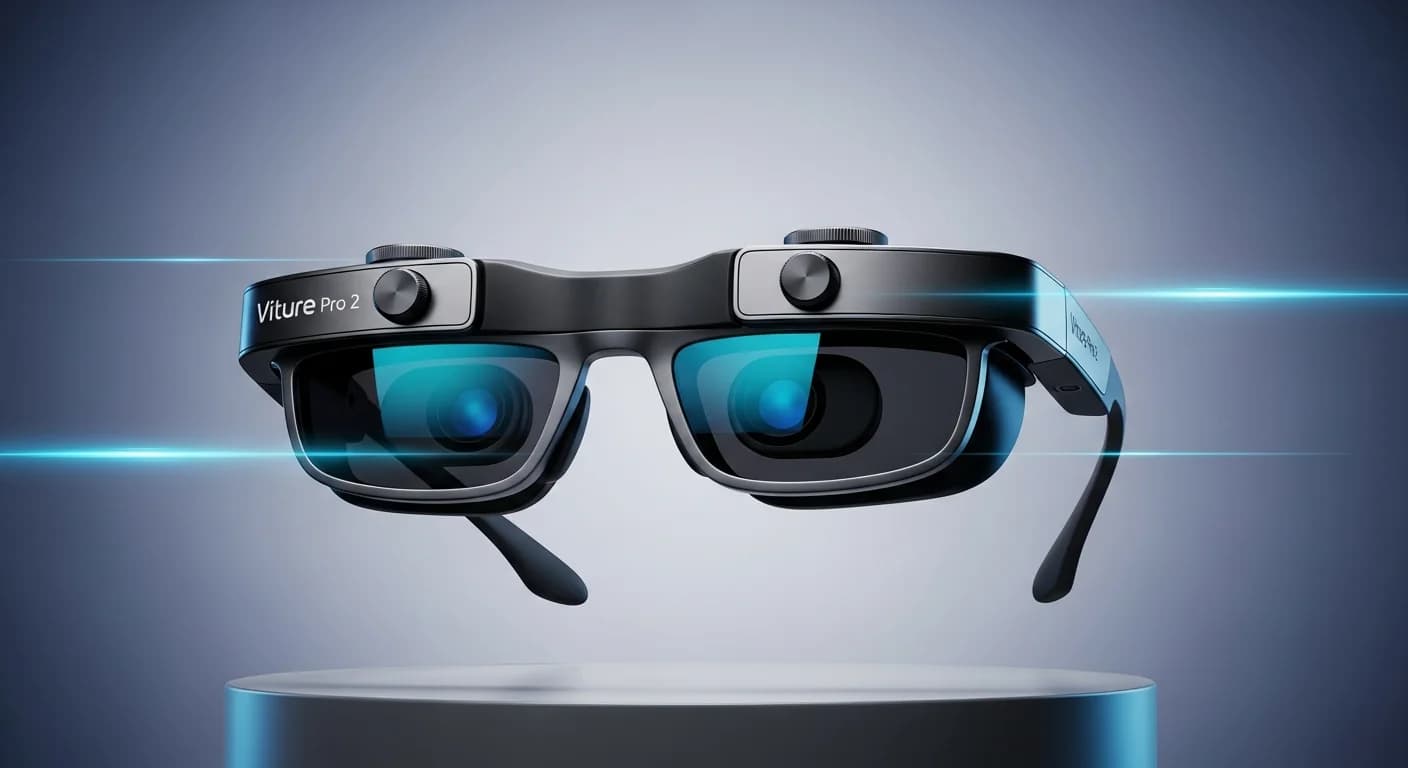
The usual rule in consumer hardware is that image quality scales with price. Viture's new Pro 2 glasses invert it. In a hands-on review, The Verge's Cameron Faulkner calls Viture's cheapest AR glasses, at $299.99, the sharpest he has seen yet, with screens sharper than models that cost hundreds more. The unglamorous secret is two small diopter dials, one above each eye.
Two dials replace the $50 workaround
Clarity is the weak spot of budget AR glasses. Most models have few or no built-in ways to fix a blurry image; the usual remedies are $50 prescription lens inserts or a return label. The dials on the Pro 2 move the lenses so more people get a clear picture out of the box, a feature that previously appeared on models sold for around $400 or more. The sharpness holds across the whole 50-degree field of view. "I didn't struggle to find a sweet spot; their entire FOV is easy to parse," Faulkner writes, whether he was reading text or picking out a minimap in a game.
The trade is a smaller field of view than some competitors offer, and the review is explicit about the priority: "I'll take smaller and sharper over bigger and blurrier." For glasses whose main job is mirroring a handheld or laptop screen, that is the right instinct.
What Viture left out to hit the price
The Pro 2 are plain screen-mirroring glasses. They connect over USB-C and mirror or extend another device's display at up to 1080p with a 120Hz refresh rate, with buttons for volume, brightness, and color temperature. There is no virtual screen placement and no head tracking; the three degrees of freedom found in pricier models are missing here, as they are on Xreal's A01 Plus, the direct rival at the same $299.99 price. The A01 Plus does add one thing the Pro 2 lack: a stabilization feature that keeps the screen still during small head movements.
The comparison turns on clarity. Faulkner needed $50 prescription lenses on the A01 Plus to get close to what the Pro 2 deliver out of the box, and even then Xreal's screens were not as consistently crisp. The other compromises are physical. At 63 grams the Pro 2 weigh one gram more than the A01 Plus. The temple arms flex more than on pricier models, and Faulkner noticed heat building up on the right temple arm during extended testing in warm weather. None of it stopped him from playing XCOM 2 and Red Dead Redemption 2 in 90-minute spurts, longer than his usual gaming sessions.
The $299.99 class, compared
| Viture Pro 2 | Xreal A01 Plus | |
|---|---|---|
| Price | $299.99 | $299.99 |
| Weight | 63 g | 62 g |
| Built-in focus adjustment | Diopter dials | None; $50 lens inserts required |
| Screen stabilization | No | Yes, for small head movements |
| 3DoF head tracking | No | No |
| Image consistency | Sharp across the full FOV | Less consistently crisp in testing |
The price band where AR glasses get serious
The number on the box matters beyond this product. Our previous coverage of the smart-glasses market noted forecasts putting the category above $30 billion by the end of the decade, with shipments growing more than 100% year over year in the first half of 2025 and AI-enabled models becoming the default configuration. The same AI-default bet is playing out across consumer tech, with Samsung's Health Assistant Beta launched with big promises and few specifics. Consumers are still spending on devices: Apple just posted a record June quarter, one helped by a tariff refund. Analysts we have covered flag the $300-400 range as the point where smart glasses reach mass-market consumers, a long way from the $1,500 price tags of early iterations and from the conditions that sank Google Glass: hardware that was conspicuous, uncomfortable, and priced for enthusiasts.
Display-mirroring glasses like the Pro 2 belong to a simpler tradition than the AI-enabled wave driving those forecasts. They take a screen from a device you already own and put it in front of your eyes. But they test the same premise: whether people will keep a screen on their face for hours at a time, which takes comfort and a sharp image without fiddling. AI tools were supposed to save time, yet a majority of workers say they add to the workload, per the Upwork Research Institute. The Pro 2 go the other way: the dials remove the fiddling entirely, at the exact price where the category's forecasts say the real market begins.
Bottom line
"The Pro 2 are excellent for the price," The Verge concludes. They are not the most capable AR glasses on the market; they are the most usable ones at $299.99, and the review says that bet pays off. Buyers who want virtual screens floating in space, or head tracking, still have to spend more. Buyers who just want a clear, big picture for a Steam Deck or a laptop now have a cheap option that gets the most important thing right.
Get the tech essentials in 3 minutes every morning
One email, every weekday, with what actually matters in AI and tech.