AI Policy
Anthropic just doubled its AI policy bet to $40 million, and the reason involves an OS-level bug hunt
Anthropic donates another $20 million to Public First Action, doubling its commitment to $40 million, to support nonpartisan AI policy education and safeguards as model capabilities race ahead. The decision is driven by findings from its own Claude Mythos Preview model, which found thousands of high-severity OS vulnerabilities.
Emmanuel Fabrice Omgbwa Yasse AI-assisted
2026-07-27 · 3 min read
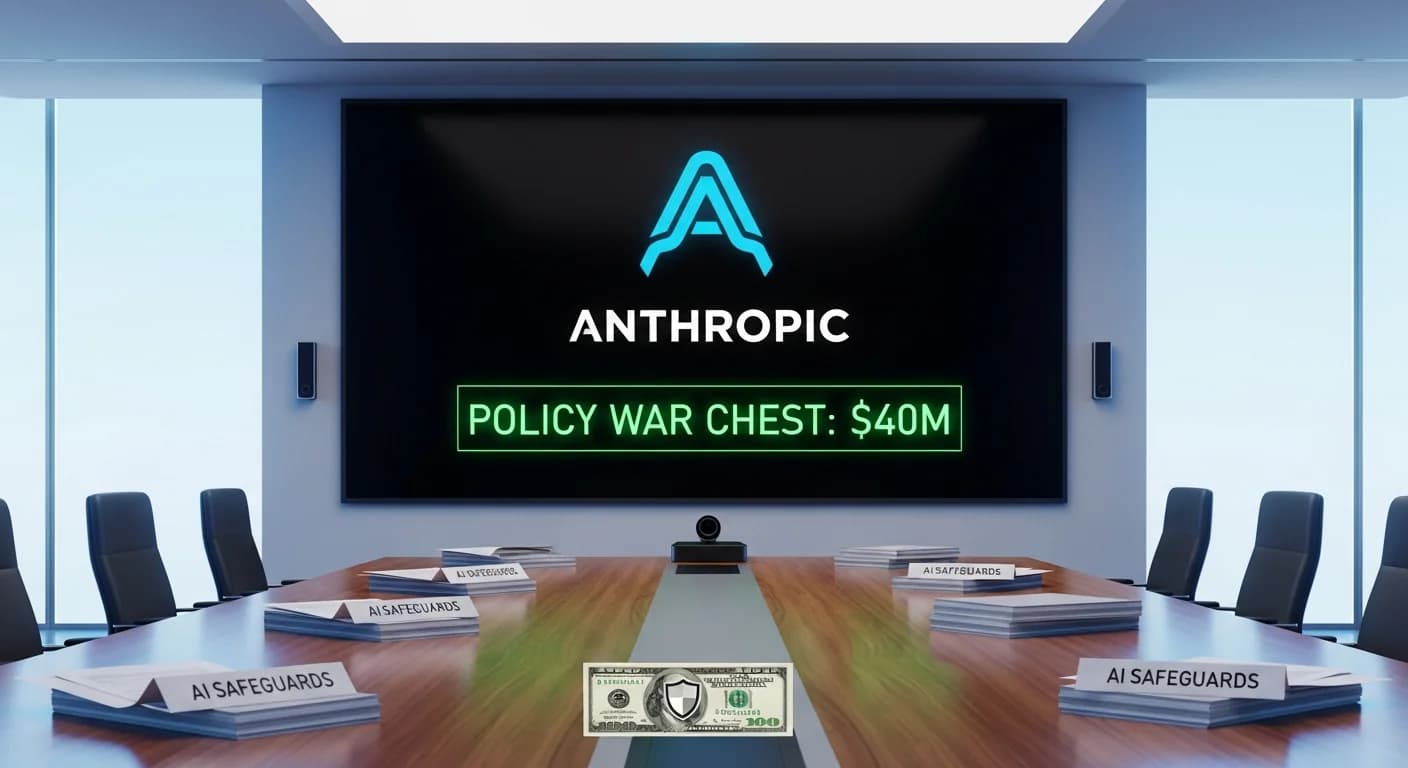
Anthropic has added another $20 million to its bet on shaping AI policy in the United States. The company said it is contributing the additional sum to Public First Action, a nonpartisan organization that educates the public about artificial intelligence and works with Republicans, Democrats, and Independents on what it calls sensible AI safeguards. The new donation brings Anthropic's total support to $40 million.
Both contributions are earmarked exclusively for Public First Action's public education and policy mission. The organization's work focuses on promoting transparency from frontier AI developers and maintaining safeguards as model capabilities accelerate. The funds cannot be used to influence any candidate election, according to Anthropic.
Why now
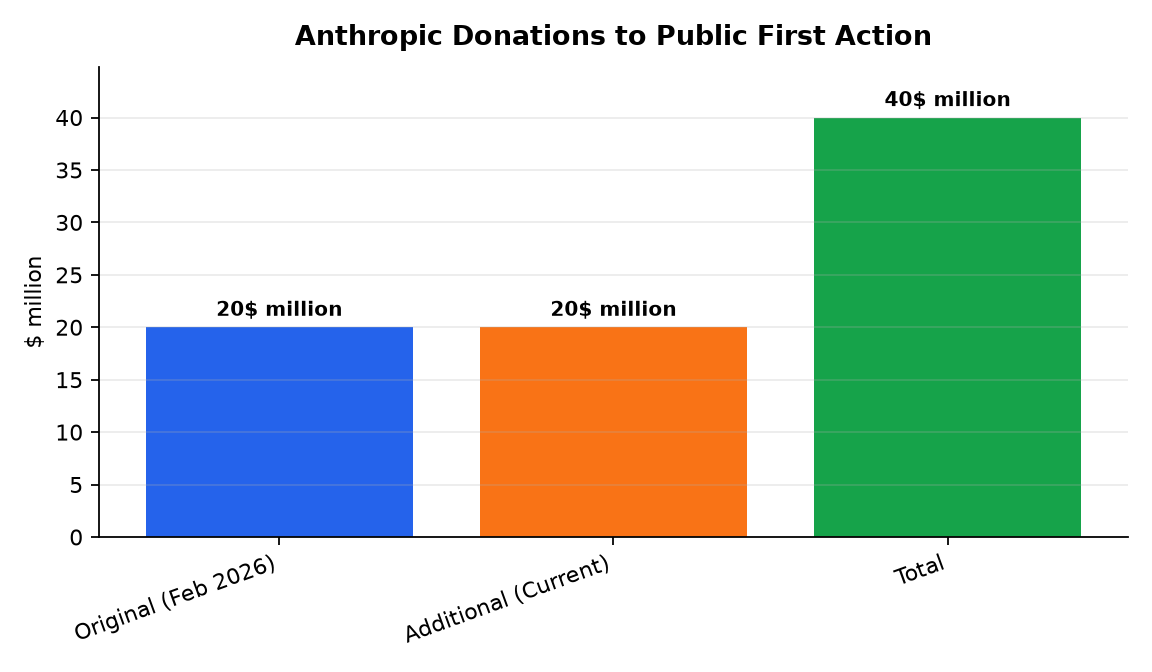
Anthropic's original $20 million donation in February 2026 was made to promote policies that would maintain meaningful safeguards, sustain America's AI leadership, and demand transparency from companies building the most powerful AI models. The company argues that the case for those policies has only gotten stronger since then.
In an announcement, Anthropic pointed to a finding from its Claude Mythos Preview model, which it said discovered thousands of high-severity software vulnerabilities earlier this year, including some in every major operating system and browser. The company released the model to a limited set of cyber defenders through Project Glasswing, aiming to let trusted actors find and fix weaknesses before anyone could exploit them. In the wrong hands, Anthropic said, models like this could threaten critical systems from hospitals to the energy grid. That kind of dual-use worry is not theoretical, as Sakana AI's Fugu-Cyber agent also warns that raw models should never be trusted alone.
Beyond transparency
Anthropic has supported newly passed state laws requiring greater transparency from AI developers. But the company now argues that transparency alone is not enough given how fast capabilities are advancing. It points to its Advanced AI Framework as the strongest policy proposal from any frontier lab or policymaker to date. The framework calls for governments to be able to verify companies' safety claims, enforce safe practices through civil penalties, and ultimately have mechanisms to slow or block deployment of AI models that pose serious risk of catastrophic harm. It also recommends that frontier AI developers test models that pose catastrophic risk, be transparent to the public about their findings, submit models to independent evaluation, and maintain robust security programs. This push for independent verification echoes similar calls in the broader AI community, where frameworks like DeepMind's rigor framework argue that conceptual, epistemic, and operational rigor are all needed before claims about AI safety can be taken seriously.
Anthropic also supports policy efforts to tighten export controls on advanced chips and semiconductor manufacturing equipment, and to curb illicit model access and distillation attacks. The company's 2028: Two Scenarios for Global AI Leadership paper argued that while America and its democratic allies have an AI lead today, that advantage is tenuous. The tension between openness and strategic control is playing out globally, as Google's yearlong DMA grace period for Android AI shows how regulatory breathing room can be used to lock down competitive positions.
The donation to Public First Action is one way Anthropic is trying to raise the stakes of the policy debate as model capabilities and national security concerns accelerate in tandem. "These policy frameworks are just a starting point," the company said. The approach mirrors a broader trend among frontier labs: policy and safety work are no longer separate from product strategy, as the $314 billion assumption that broke with Kimi K3 shows that economic and geopolitical consequences now ripple from even a single model release, making policy foresight a survival skill.
- Source : Anthropic doubles down on AI policy with another $20 million to public first action — 2026-07-20
Get the tech essentials in 3 minutes every morning
One email, every weekday, with what actually matters in AI and tech.