Artificial Intelligence
Better AI detectors might make people use AI more, not less
Imperfect LLM detectors can distort user incentives, leading to more AI use and lower quality outputs. The paper's findings challenge the naive assumption that detection tools cleanly reduce machine-generated content.
Emmanuel Fabrice Omgbwa Yasse AI-assisted
2026-07-26 · 3 min read

The intuition behind LLM detectors is straightforward: catch machine-written content, discourage its use, and protect human originality. A new paper posted to arXiv on July 21, 2026, suggests the reality is more complicated. The study, from Meena Jagadeesan and colleagues, models how users strategically respond when they know their work will be scanned for AI traces. The results run counter to what most detector advocates expect. Similar tensions have emerged in other AI governance systems, as highlighted by the $314 billion valuation shock triggered by Kimi K3.
The model: users who can game the system
The researchers built a stylized model in which a user chooses how much to rely on an LLM and how aggressively to post-process the output: rewriting, trimming, adding idiosyncrasies, to reduce whatever signal the detector picks up. The detector itself is imperfect, meaning it flags some human-written content as AI-generated (false positives) and misses some machine-written text (false negatives).
The model yields two surprising predictions. First, introducing a detector can actually increase total LLM usage. When the cost of being caught is moderate and the cost of post-processing is low, users may compensate by relying more on the LLM's raw output before cleaning it up, effectively trading detection avoidance for more machine help. Second, even when post-processing genuinely improves output quality, such as by fixing factual errors or smoothing tone, the overall effect of a detector can be lower-quality work. Users spend energy on evasion rather than on substance. This dynamic echoes the broader debate about how AI governance tools reshape behavior, as seen in the uncensored model paradox where safety guardrails trade off against user freedom.
Real-world pattern: a "rise-then-fall" in detected AI language
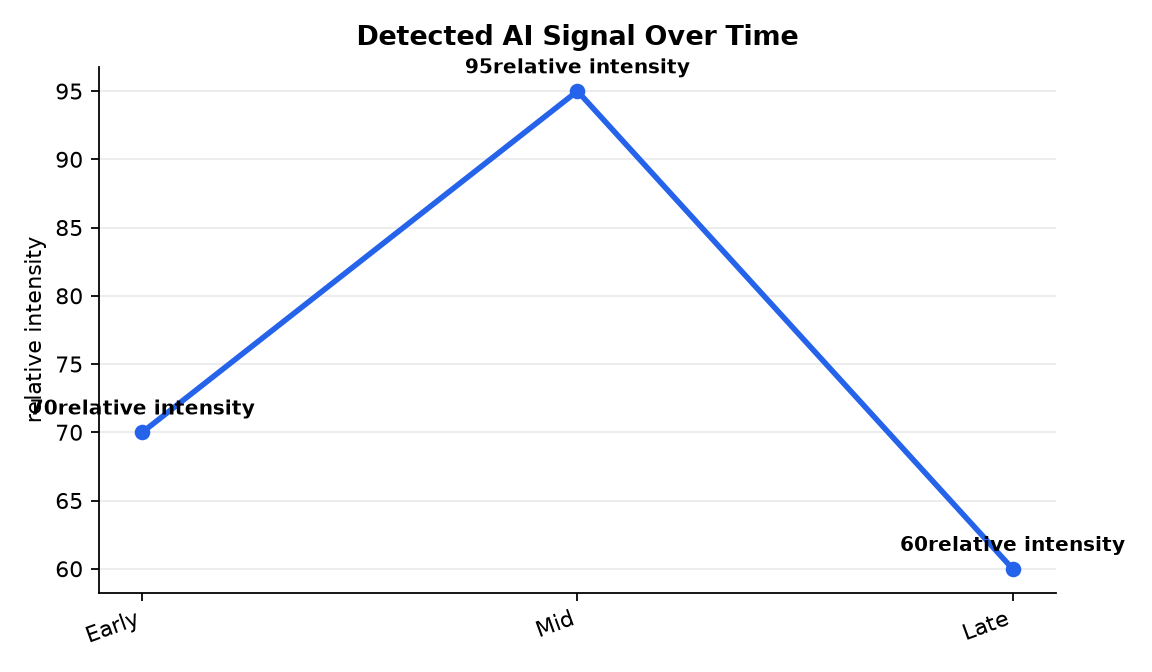
The authors do not stop at theory. They empirically reproduced the model's predicted pattern, a clean "rise-then-fall" in the detected attribute, by analyzing word frequencies in arXiv abstracts over time. The detected signal first increases as adoption spreads, then declines as users learn to adjust their writing style. The paper argues this same shape appears when detectors target superficial heuristics, like certain overused words or formulaic sentence structures. The pattern resonates with findings in other domains where users adapt to monitoring, such as the 96% context cut achieved by hierarchical agent tool architectures.
Why this matters for policy and tool design
The results unsettle a common belief in the AI governance space: that better detection automatically leads to less AI-generated content and higher quality human output. If the model holds, imperfect detectors act as distortions rather than clean filters. They shape behavior, and that shaped behavior can produce outcomes opposite to the detector's intended goal. This is reminiscent of the challenge faced by AI agents that hit 49% on a benchmark where human experts score 95%.
The paper does not argue against detection entirely. It instead calls for thinking about detectors as interventions, systems that change the incentives of the people they monitor, not as passive measurement tools. Policymakers and platform designers who deploy these tools without accounting for strategic user responses risk creating the very problems they meant to solve. Careful design is equally critical when building agents that must integrate seamlessly into workflows, as noted in the practical guide to effective prompts for Claude.
The study contributes to a growing literature on the unintended consequences of AI governance tools. It shifts the question from "how do we detect AI?" to "how does detection reshape the ecosystem it monitors?", a question that demands attention from anyone deploying these systems.
Get the tech essentials in 3 minutes every morning
One email, every weekday, with what actually matters in AI and tech.