Partnership
ElevenLabs just got the UK government to put a testbed for voice AI in public services
ElevenLabs has signed an MOU with the UK government's DSIT to test voice AI in public services, focusing on accessibility for visually impaired, elderly, and linguistically diverse communities. The company is expanding its London HQ and doubling UK staff to 200.
Emmanuel Fabrice Omgbwa Yasse AI-assisted
2026-07-28 · 3 min read

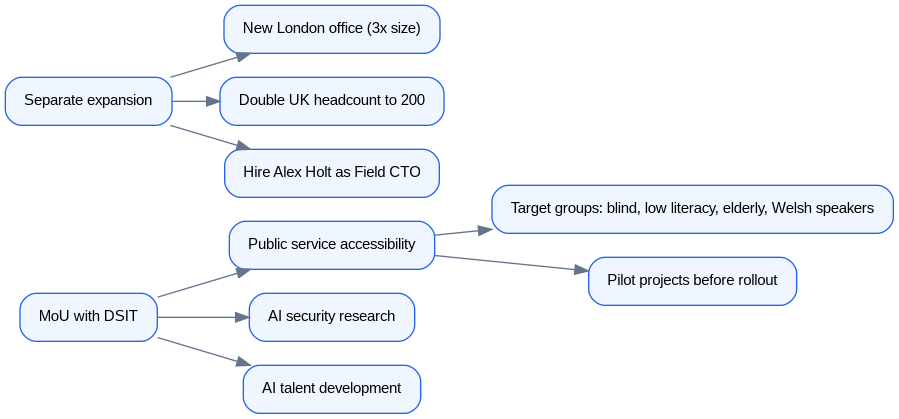
ElevenLabs is formalizing what the UK government calls a testbed for voice AI in public life. The company signed a memorandum of understanding with the Department for Science, Innovation and Technology (DSIT) on Wednesday, covering three areas: public service accessibility, AI security research, and AI talent development.
The partnership is not a procurement deal. It is an exploration agreement, structured to let DSIT and ElevenLabs run pilot projects before any larger rollout. The most concrete use case so far targets citizens who struggle with standard government interfaces: the blind and visually impaired, people with low literacy, elderly residents, and the UK's Welsh-language communities.
“Voice AI could make a real difference to how people access public services,” said AI Minister Kanishka Narayan in the announcement. “Done right, this technology won't just be cutting-edge, it will make a real difference to how people get the help and opportunities they need.”
Doubling down on London
Separate from the government agreement, ElevenLabs said it will move into a new London office triple the size of its current one and double its UK headcount to 200 people across research, engineering, sales, and enterprise teams. The company also appointed Alex Holt as Field CTO. Holt, an early employee who joined in 2023, will lead core engineering and forward-deployed teams working directly with enterprise customers.
“The businesses and governments that figure out how to integrate AI into their operations and services are going to define the next decade,” Holt said.
ElevenLabs cited several UK companies already using its voice agents: Revolut, which serves 4 million customers in 30 languages across Europe; Deliveroo, which uses voice agents for rider onboarding; and Trainline, which uses them to handle refunds. These enterprise deployments show how voice AI is moving from novelty to utility in customer-facing roles, as discussed in a broader analysis of voice AI limitations.
Already in healthcare and education
The company has existing UK partnerships that predate the MOU. In healthcare, it works with the Motor Neurone Disease Association, the Scott-Morgan Foundation, and others to provide free AI voice technology to people with conditions causing permanent voice loss, including MND and head and neck cancer. In education, it offers free API access to academic researchers at University College London and the University of Oxford, among others.
The UK is not ElevenLabs' first government partner. The company already works with the Ukrainian government to power voice features on the Diia app and provide 24/7 support hotlines designed to function during wartime. In the Czech Republic, its voice agents handle over 5,000 calls a day about employment benefits. In Greece, it works on public services, tourism experiences, and preserving endangered dialects. The model of deploying AI in sensitive public-facing scenarios raises questions about reliability and safety, similar to the concerns raised in discussions about the trade-offs between AI capability and safety.
“We want to make the UK one of the best places in the world to build, deploy and use AI,” said CEO Mati Staniszewski in the announcement. The UK expansion, he said, includes building out the company's executive team in London. The broader push by governments to integrate AI into public services reflects a wider trend that companies like Microsoft are also betting on, as they seek to balance cost and capability in AI deployment.
Get the tech essentials in 3 minutes every morning
One email, every weekday, with what actually matters in AI and tech.