Generative AI
An AI that can see its own mistakes and undo them mid-generation
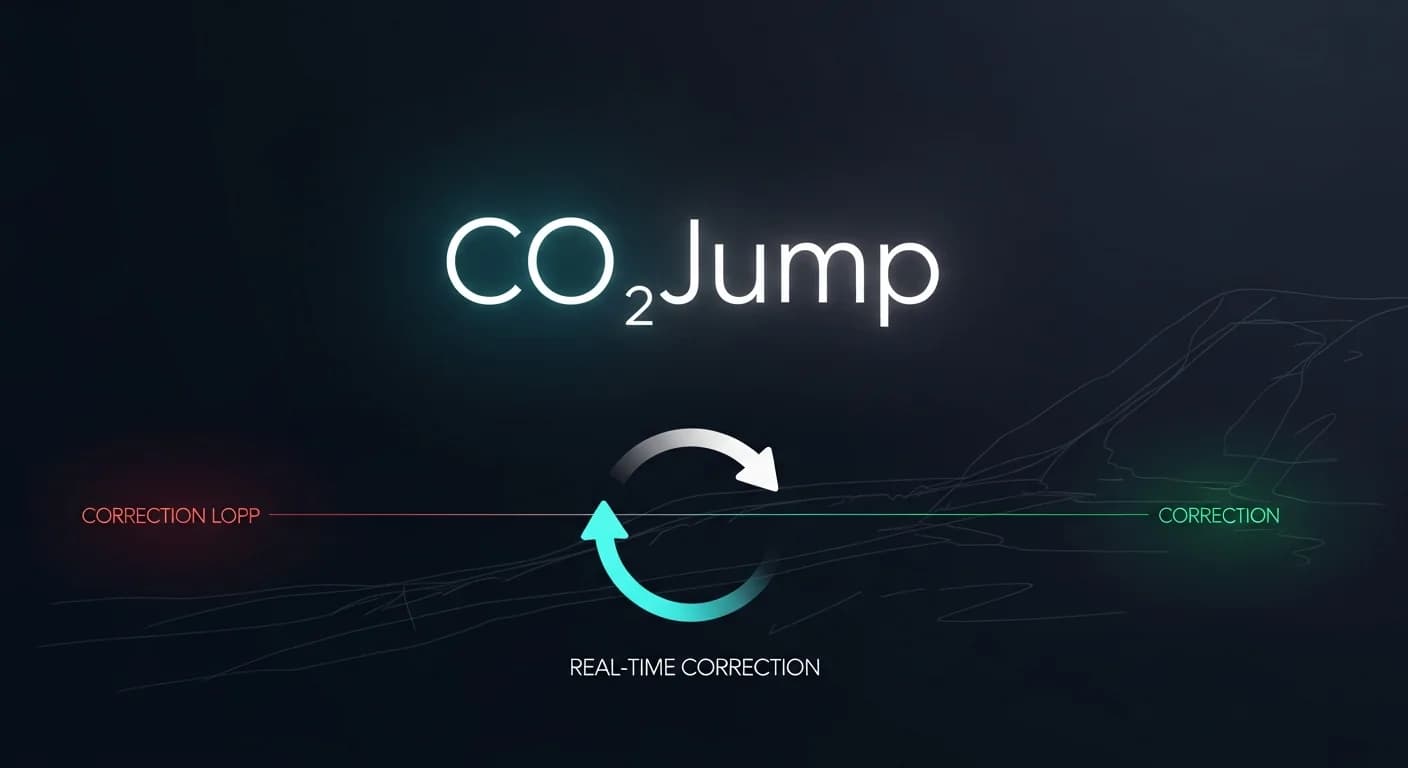
Google introduces CO2Jump, a training-free sampler for joint text and image generation. It uses a self-correcting Markov jump process where each modality's confidence scores guide the other's updates in real time, catching cross-modal errors mid-generation.
Emmanuel Fabrice Omgbwa Yasse AI-assisted
2026-07-14 · Last updated: 2026-07-19 · 4 min read
Humans don't think in separate lanes. When a teacher draws a diagram on a whiteboard, the spoken explanation and the evolving sketch shape each other in real time. Current multimodal AI systems mostly avoid this kind of coupling. They generate text, then an image from that text, or interleave the two across separate denoising steps, but each modality only has access to the other's previous output, not to its in-progress decisions.
That gap matters because it means cross-modal contradictions go unnoticed until the final output. A model might generate a caption that says "a square divided into four quadrants" while the image it produces shows a circle. There is no mechanism inside the generation process to catch the mismatch and fix it. That dynamic is one reason why building coherent multimodal outputs from scratch remains harder than it looks, as shown by research on self-correcting generation.
A team of researchers at Google, led by authors from the company's research division, has proposed a framework that tries to close this loop. The result is CO2Jump, short for Self-Correcting Coupled Jump, a training-free sampler that modifies the standard denoising trajectory of masked diffusion models (MDMs) so that text and image updates happen in a coupled, self-correcting fashion within each step.
How it works: cross-modal score weighting
The core idea builds on Masked Diffusion Models, a class of generative models that learn to reverse a corruption process applied to discrete tokens. CO2Jump wraps MDMs in a "Self-Correcting Coupled Markov Jump Process" (SC-CMJP). In plain terms, the transition probabilities that determine whether a token switches from masked to unmasked depend not just on that token's own likelihood but on the confidence score of the corresponding region in the other modality, weighted by a cross-modal attention map.

If the image generation branch is unsure about a region, the text branch slows down its unmasking decisions for tokens that attend to the region, and vice versa. This is the coupling proper. On top of that, a remasking jump allows the system to retract a previous unmasking if the other modality's confidence score for the same semantic region drops below a threshold later in the trajectory. This self-correcting behavior mirrors what other AI image models have achieved for specific text rendering, but generalized to any cross-modal mismatch.
The researchers describe the sampler as training-free because it does not require fine-tuning the underlying MDM. It uses the same pre-trained model and only modifies how the denoising steps are orchestrated.
Three new benchmarks for joint generation
To evaluate the approach, the team created three large-scale joint multimodal generation corpora, all of which they plan to release publicly. JEdit-1M contains one million image-text pairs designed for joint understanding and editing tasks. JMaze-200K and JNono-200K each contain 200,000 maze and nonogram puzzles respectively, with matching text descriptions, intended to test visual reasoning in a structured, rule-based setting. In-distribution and out-of-distribution variants are included for all three datasets.
According to the paper, CO2Jump achieves best joint performance across image understanding, image editing, and both visual reasoning tasks when compared against existing interleaved and parallel samplers. The authors report that the performance scales monotonically with the number of denoising steps, meaning the cross-modal coupling's positive effects compound over longer trajectories rather than plateauing or degrading. That monotonic scaling is reminiscent of how Nvidia observed context length as a new scaling axis for robot models, suggesting that longer, more careful generation paths yield measurable quality gains.
Why this matters for multimodal generation
The broader implication is that the quality of joint generation, where text and image are produced as a single coherent artifact, may not require a fundamentally new architecture. It may only require a smarter sampler that respects the mutual dependencies between modalities during generation itself. Most current pipelines either generate an image from a fixed text prompt (which cannot react to the image) or alternate generations across steps, which introduces latency and does not retroactively fix cross-modal errors.
CO2Jump addresses both problems in one pass. The remasking jump serves as a kind of internal critic: if the image branch decides part of a scene should look different than what the text branch has already committed to, the text branch can take back its earlier decision and try a different token. This approach is part of a broader shift toward evaluating AI systems by the human hours they save rather than by benchmark scores alone, since coherent multimodal output directly cuts revision time.
Whether the approach can scale to more than two modalities, for instance, adding audio or video, remains an open question. The paper focuses on the image-text pair, but the SC-CMJP framework is specified in modality-agnostic language, leaving that door open. As Mistral's acquisition of a physics AI startup shows, the industry is hungry for models that can handle multiple modalities seamlessly.
The project page with code and datasets is available at https://coupled-jump.github.io.
Get the tech essentials in 3 minutes every morning
One email, every weekday, with what actually matters in AI and tech.