Model efficiency
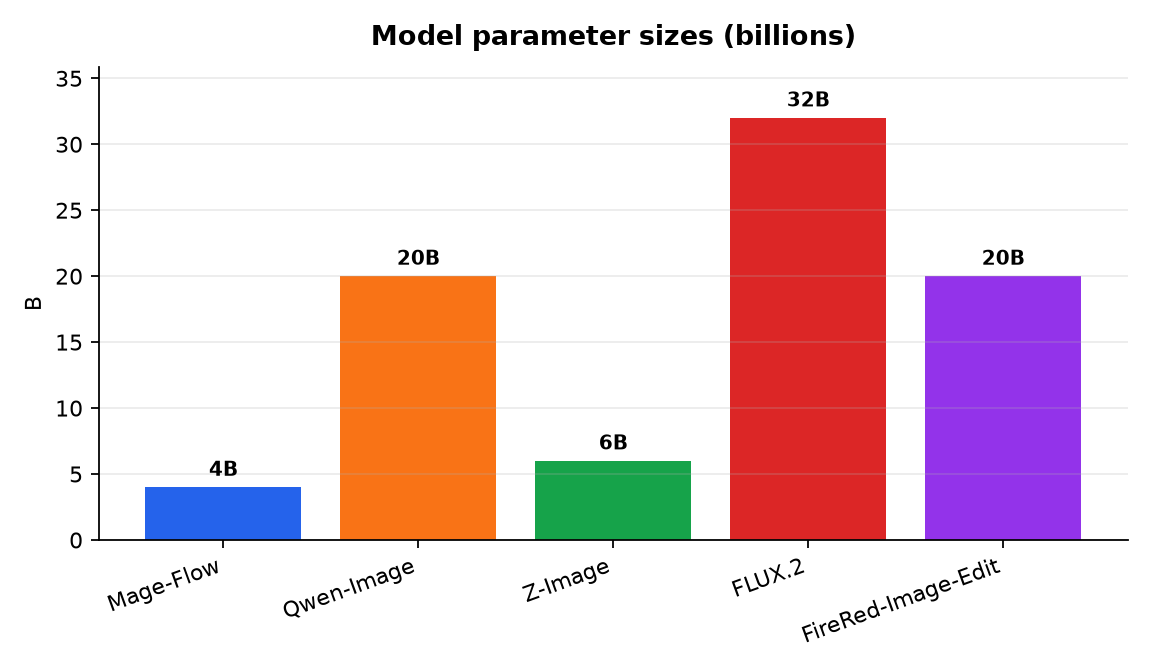
A 4-billion-parameter model just did what 30-billion systems couldn't: fit on one GPU
Microsoft's Mage-Flow is a compact 4-billion-parameter image generation and editing model that matches larger systems like Qwen-Image and FLUX.2 while running on a single A100 GPU at interactive speeds. Its key innovation is a lightweight tokenizer that cuts encoding costs by 12x and challenges the assumption that bigger models are always better.
Emmanuel Fabrice Omgbwa Yasse AI-assisted
2026-07-26 · 4 min read
Generative image models have been growing heavier by the year. State-of-the-art systems approach 30 or 40 billion parameters. But a new paper from Microsoft Research suggests bigger isn't always better, echoing the efficiency-first trend seen across recent model releases, as benchmark consolidation shows diminishing returns from raw scale.
Mage-Flow, a 4-billion-parameter stack for text-to-image generation and instruction-based image editing, matches or beats substantially larger open systems including Qwen-Image (20B), Z-Image (6B), FLUX.2 (32B), and FireRed-Image-Edit (20B), according to the paper posted to arXiv. The model runs on a single NVIDIA A100 GPU at interactive speeds: 0.59 seconds per image at 1024×1024 resolution for the Turbo variant, or 1.02 seconds for an edit.
That kind of efficiency is possible because the team at Microsoft Research Asia and collaborators redesigned the tokenizer, not just the backbone. The result is a model that does not require multiple GPUs or expensive inference setups to produce high-resolution images. This approach mirrors how MiniMax's tokenizer pre-training rethink broke a scaling wall by prioritizing understanding before generation.
The tokenizer that changes the bottleneck
Most diffusion-based generators use a Variational Autoencoder (VAE) to compress images into a latent space, then decode those latents back into pixels. The VAE is often the bottleneck at high resolutions; it needs many compute operations per pixel, and encoding and decoding eat into inference time and memory.
Mage-VAE, the paper's custom tokenizer, uses one-step diffusion-style encoding and decoding with a technique called anchor-latent regularization. The authors report it matches FLUX.2-VAE's reconstruction fidelity while using approximately 12 times fewer multiply-accumulate operations (MACs) for encoding and 22 times fewer for decoding. That effectively removes the VAE as the limiting factor when generating high-resolution images. The approach is so effective that a similarly compact model recently beat models four times its size on coding benchmarks without changing hardware.
This means a single Mage-Flow checkpoint can handle resolutions from 512 to 2048 pixels on any aspect ratio, including extreme formats like 512×2048 or 2048×512, without needing separate models for different resolutions.
System-level co-design
The stack combines Mage-VAE with a 4B Native-Resolution Multimodal Diffusion Transformer (NR-MMDiT) trained with rectified flow matching. The authors say co-design at the system level, native-resolution packing with FlashAttention, per-sample 2D RoPE positional embeddings, fused CUDA kernels, achieves about 2.5 times faster training throughput compared to standard implementations. Classifier-free guidance runs both conditional and unconditional branches in a single packed forward pass.
The family comes in three variants per task: Base, RL-aligned (which uses a Diffusion-NFT technique to improve prompt following and text rendering), and 4-step Turbo models distilled with adversarial perceptual guidance for low-latency inference. Peak memory sits around 18 to 20 GB, the lowest among comparable systems cited in the paper. That level of efficiency starts to matter when you consider the cost savings Microsoft is chasing by testing smaller, cheaper models for Copilot.
Performance and benchmarks
On standard benchmarks, Mage-Flow's Base and RL variants reach competitive scores against much larger models. The paper does not claim outright superiority on every metric, and the benchmarks it reports are standard academic ones (FID, CLIP score, etc.) rather than a proprietary suite. Independent testing will be needed to validate the claims, but the numbers the authors present put the 4B model in the same league as systems five to eight times its size.
The editing variant, Mage-Flow-Edit, supports semantic content edits, appearance transformations, image restoration, and structure-aware outputs within a single unified image-and-text-conditioned architecture. This unified approach is reminiscent of how Alibaba's Qwen2.5-Omni processes text, images, audio, and video end-to-end, though focused on generation and editing rather than multimodal understanding.
Microsoft has released the models on Hugging Face, including the Turbo variants. The paper is available on arXiv, though the authors do not mention an open-source license for the code or weights beyond the Hugging Face distribution page.
Trade-offs and open questions
Efficiency has a cost, and the paper still leaves questions. The Turbo models trade steps for latency, which can degrade quality on edge cases; the authors note the perceptual guidance helps but does not fully close the gap with the multi-step Base variant on every benchmark. The RL alignment stage uses a reward model trained specifically for this task, and the paper does not detail how well that reward model generalizes to out-of-distribution prompts.
Still, the direction is useful. If the tokenizer design holds up under independent verification, it opens a path to high-resolution image generation on consumer or mid-range hardware. That matters more than the parameter count, and it aligns with a broader trend: Nvidia and Hugging Face are already working to make distributed diffusion training accessible on smaller setups, further lowering the hardware barrier for high-quality image generation.
Get the tech essentials in 3 minutes every morning
One email, every weekday, with what actually matters in AI and tech.