Qwen / Alibaba
Alibaba splits its flagship AI model in two because one size fits nobody
Alibaba's Qwen team released Qwen3-2507, splitting its model line into dedicated instruct and thinking variants. The update brings substantial gains in reasoning, instruction following, and 256K context support, extensible to 1M tokens.
Emmanuel Fabrice Omgbwa Yasse AI-assisted
2026-07-29 · Last updated: 2026-08-03 · 2 min read
Alibaba's Qwen team is walking back its unified-model bet. The new Qwen3-2507 release splits the line into two distinct variants: one optimized for instruction following and general-purpose chat, the other purpose-built for reasoning-heavy tasks like math, science, and coding. The move reflects a broader industry shift, with more labs concluding hybrid architectures force compromises neither use case needs, as earlier compact models demonstrated.
The move marks a sharp departure from Qwen3-2504, which shipped a single architecture that could toggle between thinking and non-thinking modes depending on the query. The new release acknowledges that a jack-of-all-trades approach forced trade-offs neither use case needed to accept.
Two models, two jobs
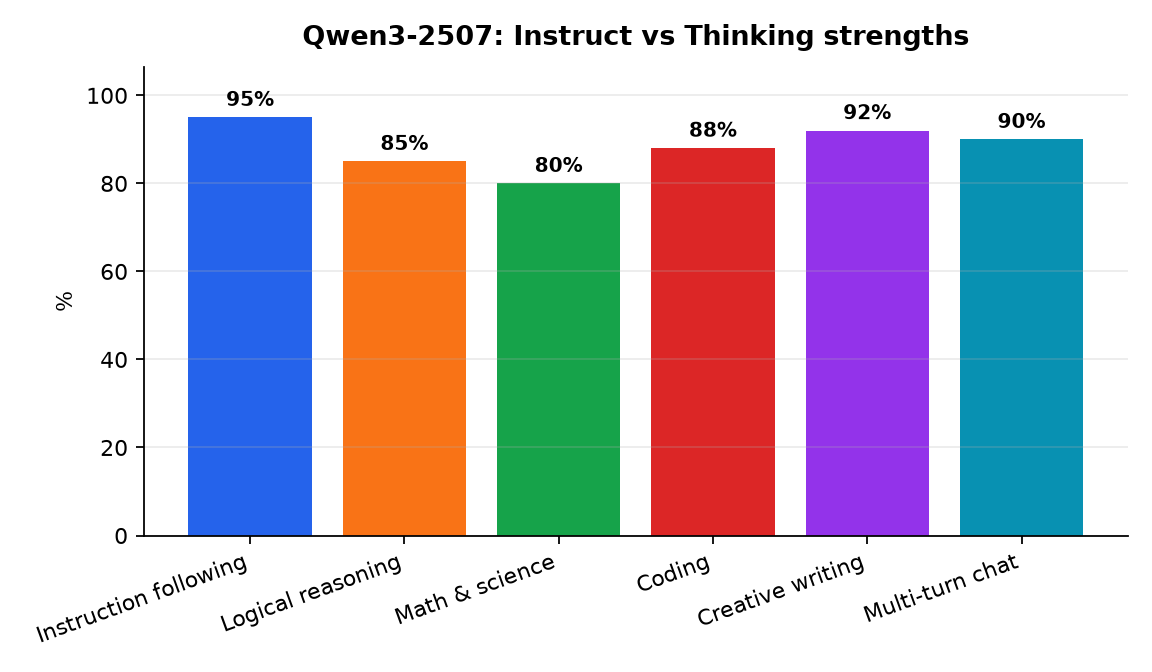
Qwen3-Instruct-2507 focuses on breadth. The team touts gains in instruction following, logical reasoning, text comprehension, mathematics, science, coding, and tool use. It also claims markedly better coverage of long-tail knowledge across multiple languages and improved alignment on subjective tasks, creative writing, role-play, and multi-turn conversation. Context support sits at 256K tokens, extensible to 1M. This aligns with the Qwen team's quiet expansion into specialized model families.
Qwen3-Thinking-2507 goes deep on reasoning. The release calls it "state-of-the-art among open-source thinking models" on benchmarks that typically require human expertise: logical reasoning, math, science, coding, and academic tests. It also gets the same 256K context ceiling, expandable to 1M.
The split mirrors a wider industry oscillation. Earlier this year, the trend favored hybrid models that could decide when to think hard and when to answer fast. A growing number of labs now conclude that the cognitive overhead of switching modes inside a single set of weights degrades performance at both ends, making dedicated variants the cleaner engineering choice. This mirrors similar trade-offs found in vision-language models.
Where Qwen3-2504 sits now
The earlier Qwen3 release isn't going away. The team still maintains the dense and MoE models ranging from 0.6B to 235B-A22B parameters, with their signature seamless switching between thinking and non-thinking modes. Qwen3-2504 remains the right pick for deployments that need a single model to handle both heavy reasoning and fast chat without managing two inference endpoints. But for teams that know what they need, Qwen3-2507 removes the guesswork. The instruct variant optimizes for helpfulness, creativity, and breadth. The thinking variant optimizes for depth, precision, and benchmarks. The price of admission is choosing one before inference instead of letting the model decide on the fly, a design Alibaba's broader platform strategy increasingly favors.
- Source : Qwen documentation
Get the tech essentials in 3 minutes every morning
One email, every weekday, with what actually matters in AI and tech.