AI Engineering
83 Claude Code tips just became a community wiki, and it reveals the new skill that matters
A community-maintained GitHub repo collects 83 tips for Claude Code, documenting the shift from vibe coding to agentic engineering. The resource reveals context budgeting as the new core skill.
Emmanuel Fabrice Omgbwa Yasse AI-assisted
2026-07-29 · Last updated: 2026-08-03 · 6 min read
If you have used Claude Code for more than a few hours, you have probably hit the wall: context rot sets in around 300,000 tokens, the model starts answering its own questions, and your session turns into a slow spiral of increasingly expensive corrections. Until now, the fixes lived in scattered tweets and YouTube comments. A single GitHub repo is trying to change that, and the implications go beyond one tool, as Anthropic's broader security approach suggests the company is serious about making Claude a managed engineering resource.
Developer Shan Raisshan has assembled what is effectively the first community field manual for Claude Code. The repository, which tracks at more than 200 GitHub stars as of April 2026, documents 83 tips across fourteen categories, plus agent and skill collections from the broader ecosystem. It pulls from Anthropic engineers, the Claude Code creator Boris Cherny, and community power users including Matt Pocock and Andrej Karpathy.
What makes the resource notable is not the sheer number of tips but the way they harden into something resembling a professional discipline. The repository explicitly frames its material as a move from vibe coding, Andrej Karpathy's 2025 term for letting the model drive without much understanding, toward agentic engineering, where developers orchestrate subagents, manage context budgets, and build reusable workflow primitives.
Context budgeting becomes the core skill
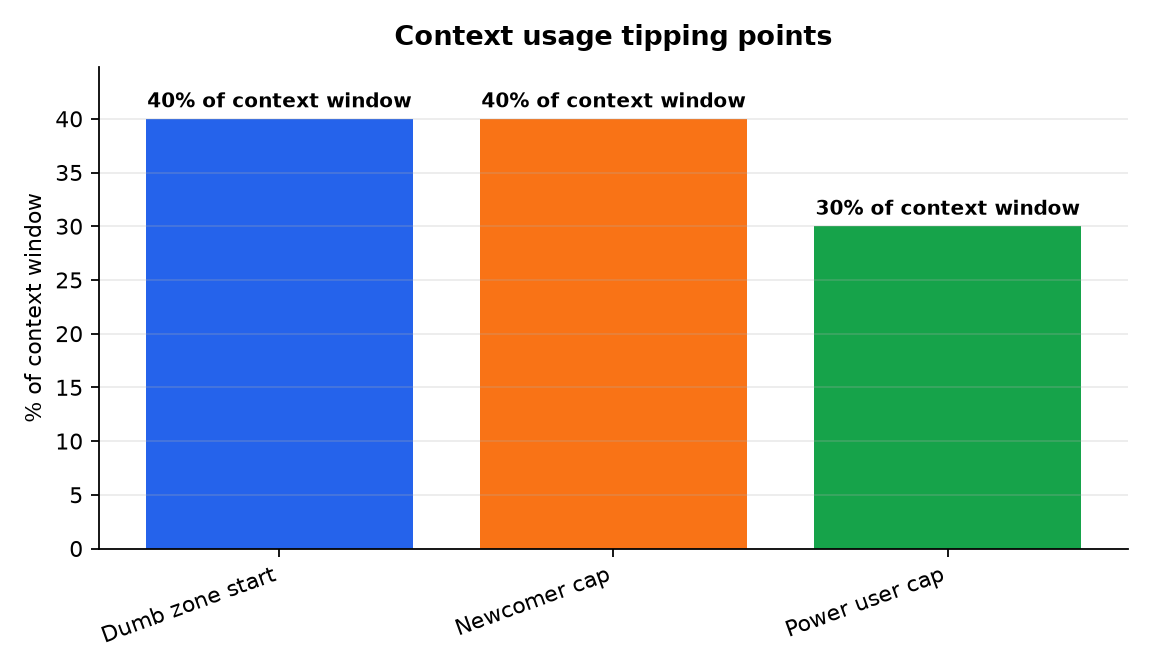
The first thing any heavy Claude Code user notices is that the model degrades as the conversation window fills. The repo documents the thresholds with unusual precision: context rot becomes noticeable around 300,000 to 400,000 tokens on the 1-million-token model. One comment, attributed to an anonymous Anthropic engineer who goes by the handle Thariq, defines a "dumb zone" at roughly 40 percent context usage. Newcomers are told to stay under 40 percent. Power users are told to push no further than 30 percent, and only for simple tasks. This mirrors findings in agent working memory research, where state tracking failures emerge at similar thresholds.
The recommended response is a tiered system of session management. The /compact command with a hint, /compact focus on the auth refactor, drop the test debugging, beats letting autocompact fire, because the model's auto-trigger fires when context already hurts performance. The /clear command plus a brief re-prompt gives the developer full control over what carries forward, at the cost of typing out a short summary. The repository marks both as essential, not optional.
Rewinding to a previous checkpoint before a bad attempt is treated as better than trying to correct the model in place. Double-Esc or /rewind resets the conversation to a point before the mistake, and the developer re-prompts with what they learned. Leaving failed attempts in the conversation wastes tokens that the model then has to work around.
Primitives over prompts
The repository's organizing thesis is that Claude Code power users do not write better prompts. They build better abstractions. The three core primitives are agents, commands, and skills. This shift from prompt engineering to abstraction design echoes the architectural lessons from Microsoft's FLINT visualization language, which hides boilerplate behind primitives rather than relying on prompt quality.
Agents are subagent definitions living in .claude/agents/ as markdown files. They are designed to handle specific roles, a QA agent, a backend specialist, a PR reviewer, and run in separate context windows. The main session sees only the subagent's conclusion, not its intermediate tool calls. That isolation is the entire point: 20 file reads, 12 grep searches, and 3 dead ends stay inside the child context, and only the final report returns.
Commands are slash-triggered workflows stored in .claude/commands/. The repository recommends building one for every inner-loop task you do multiple times a day. A /techdebt command or /context-dump command replaces a repetitive prompt chain with a single keystroke.
Skills are folders with a SKILL.md entry point, plus optional subdirectories for scripts and examples. The skill's description field is treated as a trigger, not a summary, the model uses it to decide when to fire. The repository advises against prescriptive step-by-step instructions: give goals and constraints, not a recipe. A Gotchas section in each skill is called out as the highest-signal content, collecting Claude's failure modes over time. The ability to centralize and sync these skills across teams echoes the problem addressed by Alibaba's Nacos Skill Sync, which tackles the same fragmentation at scale.
One detail that stands out: skills can embed shell commands via !command in the SKILL.md. Claude runs the command on invocation, and the model sees only the result. That allows a skill to inject dynamic context, current branch, changed file list, last CI run status, without the developer having to redirect output into the conversation.
The workflow pattern that keeps surfacing
Across the ten featured workflow repositories in the community collection, one structural pattern repeats: Research, Plan, Execute, Review, Ship. The repository documents it as a loop with sub-loops. The yellow tags in the workflow table, the sub-loops, are what make the pattern work for each use case. A per-task loop inside Execute. A per-story loop inside Plan. A verify-loop on Review that repeats until condition passes.
The cross-model workflows are a newer addition. Three distinct mechanisms exist: plugins, where another model's CLI runs inside Claude Code as a slash command; MCP servers, where Claude Code calls another model as a tool; and routers, where Claude Code's API endpoint is swapped to a different provider. The OpenAI Codex plugin is the most notable: it provides /codex:review, /codex:adversarial-review, and /codex:rescue commands inside Claude Code, effectively letting one model QA the other's output. Multi-agent orchestration of this kind is a recurring pattern, as seen in Sakana AI's Fugu system, which combines multiple models in a swarm for improved outcomes.
83 tips, one signal: the discipline is maturing
The volume of tips is secondary to what they represent. A year ago, advice for using AI coding assistants amounted to "be specific in your prompts" and "break your work into small chunks." The Raisshan repository shows a community that has moved well past that. There are tips for using git worktrees for parallel development with agent teams. Tips for using ASCII diagrams to communicate architecture to the model. Tips for building product verification skills that cost a week to perfect but pay off across every subsequent sprint.
The repository itself acknowledges that the notes are a moving target. The tips table lists 83 items as of April 2026, and the repo instructions invite contributions. A section titled "Questions Without Answers" lists fourteen open problems, including the balance between commands, agents, and skills, and whether specs as markdown files survive the rate of code generation. The unanswered questions may be the most honest part of the document.
The full repository is available on GitHub. The community tips section alone is worth the visit, especially for teams still treating Claude Code as an autocomplete tool rather than a managed engineering resource.
Get the tech essentials in 3 minutes every morning
One email, every weekday, with what actually matters in AI and tech.