Behavioral science
LLMs just bypassed the hardest part of behavioral economics: expensive surveys
A study using 3,000 GPT-5-based agents in route choice experiments shows LLMs reproduce cumulative prospect theory biases, loss aversion, reference dependence, probability weighting, with high fidelity. The approach bypasses the bottleneck of parameter estimation that limits traditional behavioral modeling.
Emmanuel Fabrice Omgbwa Yasse AI-assisted
2026-07-28 · 6 min read
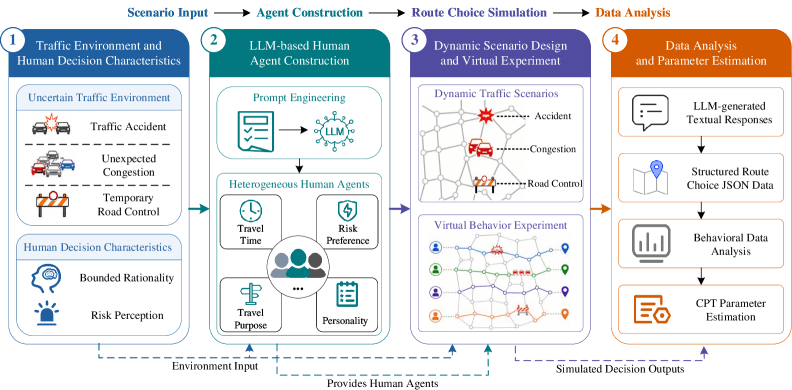
For decades, modeling how real people make decisions, especially under risk and uncertainty, hit a hard practical wall. Cumulative prospect theory (CPT) captures the biases classical economics ignores: loss aversion, reference dependence, the tendency to overweight tiny probabilities. But to use CPT at scale, researchers need individual-level parameters that are stubbornly expensive to collect. Surveys are small. Controlled experiments are homogeneous. The diversity of human decision-making stays out of reach.
A team from Tianjin University and the University of Nottingham Ningbo China has published what may be the first systematic demonstration that large language models can sidestep that bottleneck entirely. In a preprint titled "Reproducing human biases in route choice using large language models," the researchers show that LLM-based agents, 3,000 of them, each with a distinct demographic and psychological profile, produce choice patterns that map onto CPT's predictions with a goodness-of-fit above 0.93 for gains and 0.95 for losses.
“These findings suggest that generative AI models may provide a scalable alternative for modeling human decision processes,” the authors write. The implication: agent-based simulations, long constrained by the difficulty of giving virtual agents realistic behavioral heterogeneity, could now be built at a fidelity previously reserved for small human-subject experiments. According to the vibe coding analysis, such scaling often hides costs, but here the cost advantage is structural.
From questionnaires to generative agents
The bottleneck the paper addresses is not theoretical but logistical. CPT describes choice behavior through a value function and a probability weighting function, governed by parameters that encode how sensitive a person is to gains versus losses, how steeply they discount probability differences, and where they set their psychological reference point. Estimating these parameters historically meant running surveys of a few hundred participants at most, 160 usable records from a Washington-area travel survey, or a handful of postgraduate students in a lab experiment. The resulting parameter sets describe a group average, not the spectrum of real-world heterogeneity. See also the 26,000-student study on cognitive debt for how survey-scale biases can mislead.
The Chinese team's approach replaces human respondents with LLM-based agents. Using a nonparametric prompting architecture, they created ten agent profiles, a retired worker going to the hospital, a courier making deliveries, a vlogger reviewing locations, each with explicit risk preferences, time sensitivity, and travel purpose. For each profile, they generated 300 agents, yielding 3,000 virtual subjects. These agents were then exposed to route choice scenarios where the same average travel time hid different risk distributions: some routes had stable but mediocre outcomes; others offered the chance of a large gain alongside a real risk of loss.
“Heterogeneous human agents with multidimensional attributes are constructed based on LLMs through standardized prompts,” the authors explain. The agents did not receive CPT parameters; they received a description of who they were and what they valued, and were asked to pick a route.
The biases the LLMs reproduced
The paper tests two canonical CPT predictions. First, that people are risk-averse in the domain of gains and risk-seeking in the domain of losses. Second, that the asymmetry is not symmetric: losses hurt roughly 1.43 times more than equivalent gains feel good, a figure the study derived directly from the LLM-generated choices. The estimated parameters, α = 0.4 for gain sensitivity, β = 0.64 for loss sensitivity, and λ = 1.43 for loss aversion, fall within the range of values reported in human studies.
Crucially, the agents did not follow their risk labels mechanically. When type-1 agents, retired workers described as cautious and meticulous, were placed in a loss scenario where route A had zero probability of on-time arrival, they flipped to the more volatile route B. “This suggests that while they are generally risk-averse, they re-evaluate the outcome distribution when lateness is unavoidable,” the authors note. The vlogger and college student profiles, described as risk-seeking, overwhelmingly chose the high-variance route, but not uniformly across all scenarios, indicating context-sensitive decision-making rather than a fixed policy. Tools like SkillCoach have shown that agents often pass tests by accident; here the pattern looks intentional.
The study also extracted reference points, the psychological benchmark against which gains and losses are measured, from the agents' expected travel times. Rather than imposing a fixed reference, the LLM agents each formed an individualized expectation; the aggregate of these expectations produced a reference point that shifted with the scenario, reflecting the same context dependence that behavioral economists observe in human subjects.
Scaling behavior without scaling costs
The practical promise of this approach is not just that it works, but that it works cheap. Running 3,000 agents through 11 scenarios in three replicates would be prohibitively expensive with human subjects, both in recruiting costs and in time. The LLM-based simulation produced structured JSON output ready for statistical analysis, with minimal human oversight beyond prompt design. As DSpark showed for fast inference, cost savings come from the systems approach, not model tweaks.
The authors are clear about what they have not proven. Their study does not test whether LLMs can reproduce every known behavioral bias, only the CPT-relevant ones in a route choice context. The agent profiles, while diverse, remain a simulation of diversity, not a validation against real population data. And the use of a single model, GPT-5, leaves open the question of whether the result generalizes across model families or temperature settings.
Still, the paper opens a door that behavioral modelers have been pushing against for years. If LLMs can generate synthetic behavioral data that accurately reflects human bias structures, then the bottleneck shifts from data collection to prompt engineering, a constraint that is, at least in principle, easier to scale.
The road ahead for generative behavioral modeling
The Tianjin team's work fits into a broader push to use LLMs as what some researchers call "computational social science in a box." Earlier work from Stanford's generative agents project showed that LLM-based agents could simulate information diffusion and social aggregation in a sandbox environment. This paper extends that logic to a tightly parameterized behavioral framework, suggesting that the same agents can serve as stand-ins for human subjects in experiments designed to measure specific cognitive patterns. See the Microsoft research on brain-prediction AI for another angle on using generative models to understand cognition.
The next question, which the paper does not answer, is whether the parameters estimated from LLM agents would match those estimated from real human behavior in the same scenario. The study stops at showing that the agents' choices are consistent with CPT; it does not compare the resulting parameter estimates against human-collected baselines. That comparison would be the natural next step, and the authors acknowledge it indirectly in their closing suggestion that future research should examine "different AI models and real-world user decision-making comparison."
For practitioners in transportation modeling, urban planning, and agent-based simulation, the paper offers a concrete methodology. The standardized prompt architecture is modular: the same profile and planning components could be adapted to mode choice, departure time, or even financial decision-making scenarios. The code and prompt templates are not yet publicly released, but the paper provides enough detail to replicate the approach. The parallel with the unified search toolkit for AI plumbing is apt: both solve infrastructure bottlenecks, not just model improvements.
If the results hold across domains and models, the bottleneck that has constrained behavioral modeling may finally have a workaround, one that runs on an API call rather than a clipboard and a clipboard.
Get the tech essentials in 3 minutes every morning
One email, every weekday, with what actually matters in AI and tech.