Advanced Parametric Head Modeling for Animation and Medical Use
The missing teeth of parametric face models: GNM head fills them in
GNM Head models the full human head including teeth, eyes, tongue, and neck, built from high-res scans and available open source.
Emmanuel Fabrice Omgbwa Yasse AI-assisted
2026-07-30 · Last updated: 2026-08-03 · 2 min read
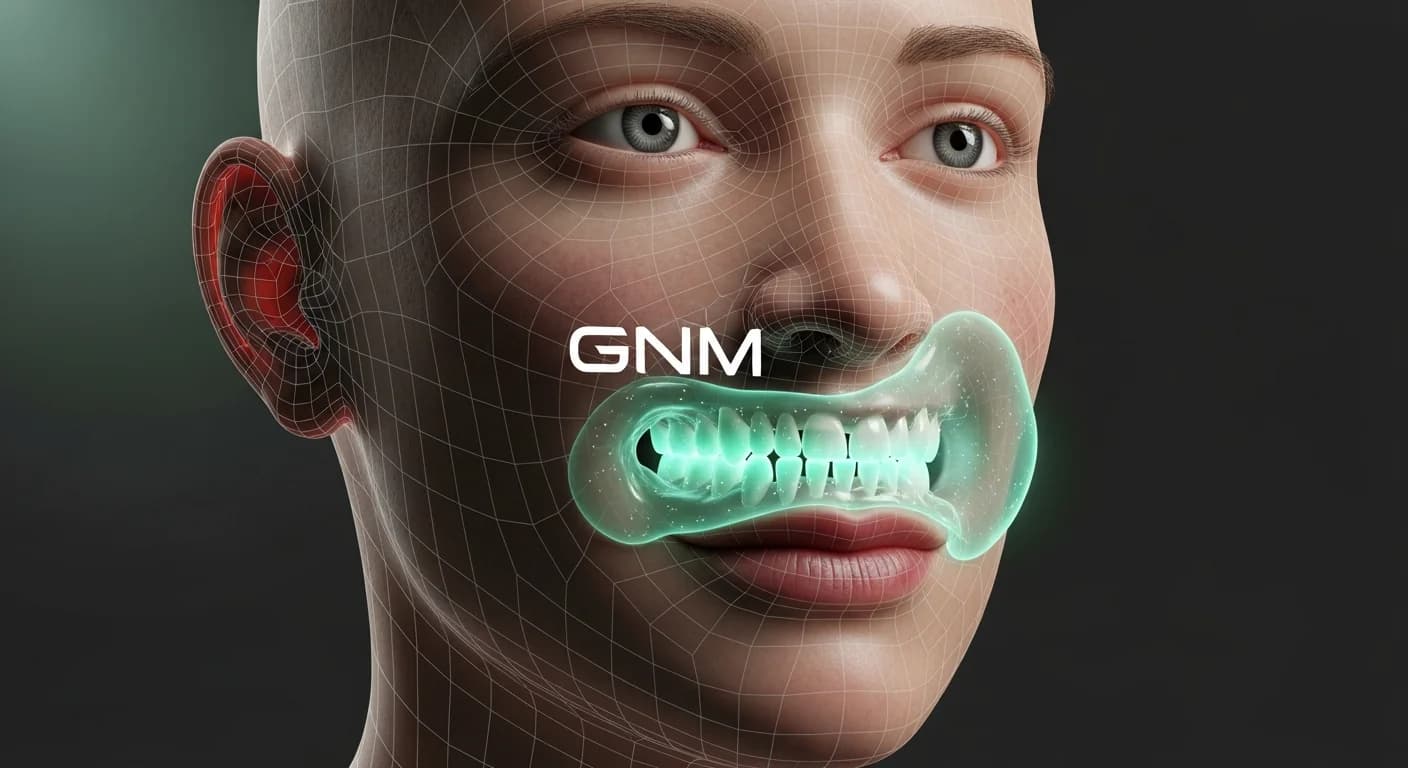
Parametric head models used in animation, VR, and medical imaging have long treated the face as an outer shell. They cover the skin, nose, and lips but skip the internal structures: the teeth that shape speech, the tongue that moves, and the eyeballs that track.
That changes with GNM Head, introduced in a preprint by a research group that does not credit a specific institution in the abstract. The Generative aNthropometric Model, abbreviated GNM and named as a homophone of "genome," covers the head, face, neck, eyeballs, teeth, and tongue. It is built from a large database of high-resolution 3D scans paired with anatomy-specific artist-made samples, the paper states.
GNM is a parametric model, meaning its shape is controlled by adjusting a set of parameters. This makes it useful for fitting to new scans, generating variations, or conditioning generative vision models. The authors report state-of-the-art performance on fitting target 3D face scans, though specific benchmark numbers are not detailed in the abstract.
GNM is the first publicly available parametric model to include internal head structures. Existing popular models like FLAME are limited to the outer face. GNM addresses that limitation, with potential applications in dental modeling, speech animation, and realistic avatar creation.
For computer graphics, the inclusion of intra-oral geometry opens new possibilities for realistic facial animations that include the mouth interior, a well-known challenge in the field. In medical contexts, a parametric model of the full head could aid in surgical planning, prosthetics design, or understanding variation in human anatomy. The model also includes eyeballs, which are critical for realistic gaze and expressions.
The combination of high-resolution scans and artist-created anatomy gives the model a high level of detail. The authors note that existing datasets have suffered from low fidelity, but GNM's data sourcing is designed to avoid that limitation.
GNM's parametric representation can serve as a conditioning signal for generative models, giving tight control over generated head images, the authors note. This joins a broader wave of vision-language and multimodal research, including work on visual tokenization via ViQ and long-video understanding with Nvidia's AV-Flamingo.
The complete GNM framework is made publicly available for community use. Researchers and developers can access the code and data via the paper's page on Hugging Face, part of a larger push for open-weight AI supported by 41 organizations, though licensing terms are not specified in the abstract.
For those working on digital humans or computational anatomy, GNM Head provides a tool that has been missing a set of teeth and a pair of eyes. Whether it gains adoption will depend on ease of use and community support, but the release at least acknowledges a blind spot in parametric modeling that few have addressed.
- Source : The missing teeth of parametric face models: GNM head fills them in — 2026-07-26
Get the tech essentials in 3 minutes every morning
One email, every weekday, with what actually matters in AI and tech.