Artificial intelligence
What breaks when AI agents leave the lab: a production reality check
A new tutorial on agentic systems highlights the gap between benchmark success and production reliability. Researchers share concrete patterns for handling failures, from verification pipelines to human-in-the-loop design, drawing on case studies in drug discovery and finance.
Emmanuel Fabrice Omgbwa Yasse AI-assisted
2026-07-24 · 5 min read
For the last two years, the conversation around agentic systems has been dominated by a single question: how high can they score on the latest benchmark? The answers have been impressive enough to fuel a gold rush of startups and enterprise pilots. But a new tutorial, submitted to arXiv on July 21, 2026, suggests the more urgent question is a different one: what happens when these systems actually have to work, day after day, in environments where mistakes cost real money? The gap between benchmark scores and production reliability is well documented, as covered in the LiveBench analysis showing diminishing returns at the top.
Agents in the Wild: Where Research Meets Deployment, authored by a coalition of researchers and practitioners, pulls together lessons from production-scale deployments across software engineering, scientific discovery, and finance. Its stated goal is to bridge the gap between algorithmic innovation and reliable operation. What it actually delivers is a sobering catalog of what breaks when agentic systems leave the lab.
The gulf between benchmark and production
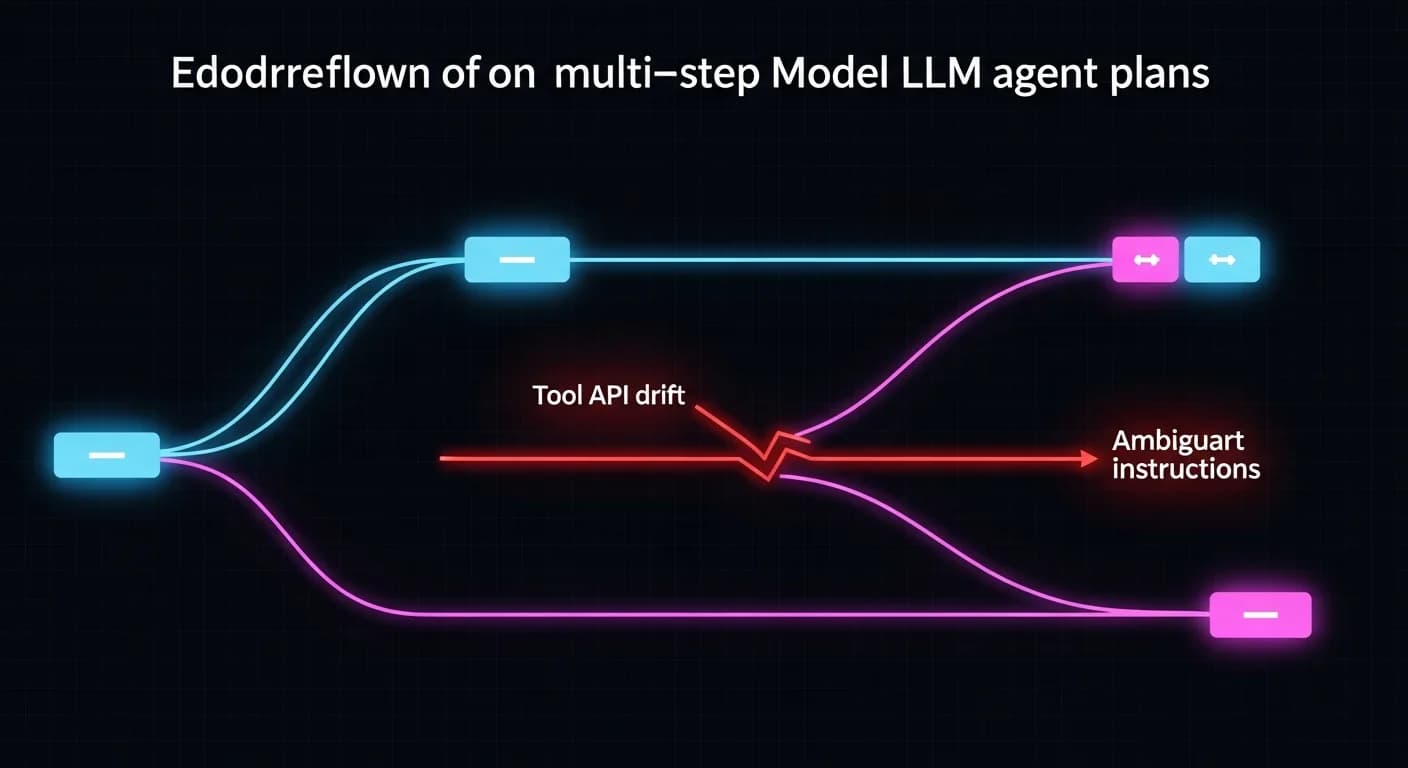
Academic benchmarks typically test agents on isolated tasks with clean inputs, known success conditions, and no distribution shift between evaluation runs. Production environments supply none of these luxuries. The tutorial documents failure modes that are invisible in controlled settings: tool APIs that change without notice, ambiguous user instructions that no benchmark captures, and multi-step plans that fail halfway through, leaving an agent in a state it was never trained to handle. This disconnect between controlled tests and real-world behavior echoes findings from PawBench, which evaluates agents in their actual harness environment.
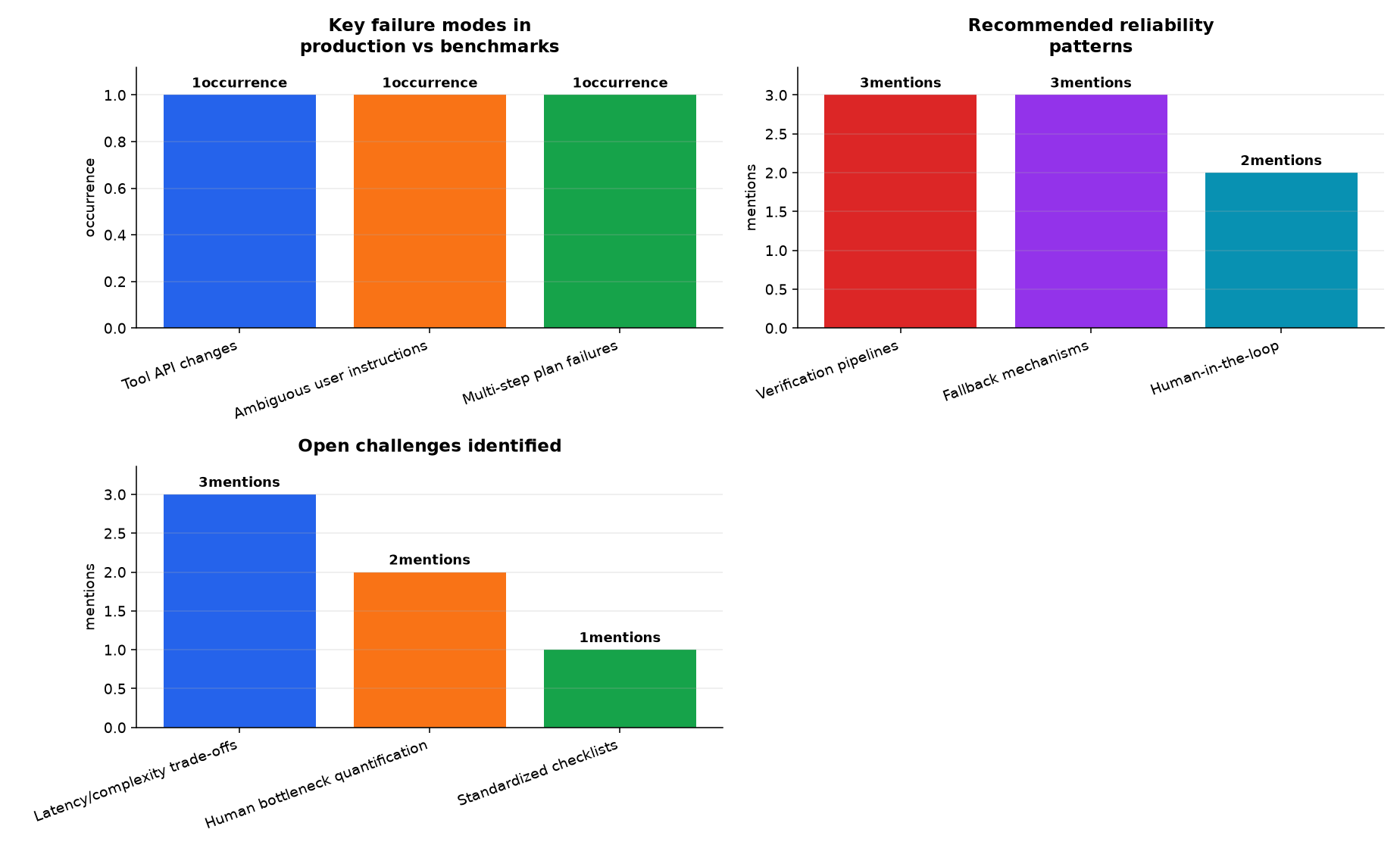
One of the tutorial's central claims is that robust deployment requires a fundamentally different evaluation mindset. Rather than optimizing for peak accuracy on a fixed test set, teams need to design for graceful degradation under conditions they cannot fully anticipate. The paper offers a set of concrete design patterns for this, including verification pipelines that check intermediate outputs before letting an agent proceed to the next step, fallback mechanisms that kick in when a primary model fails, and human-in-the-loop supervision for high-stakes decisions. These recommendations align with the structural approaches explored in hierarchical skill architectures for AI agents.
This emphasis on safety infrastructure rather than raw capability is the tutorial's most distinctive contribution. It reflects a maturing understanding of what it means to build systems that users can actually trust, as opposed to systems that merely impress on a leaderboard. The tutorial's focus on infrastructure echoes insights from Nacos Skill Sync, which addresses agent coordination at the infrastructure level.
Two case studies, two lessons
The tutorial grounds its recommendations in two detailed case studies: one in pharmaceutical discovery and another in financial systems. The pharmaceutical example illustrates the value of multi-agent coordination in a domain where different reasoning steps require different specialized knowledge. A molecule-screening agent might flag a promising candidate, then hand off to an ADME-toxicity prediction agent, then to a synthesis plausibility checker, with each step subject to its own verification gate. The tutorial argues that this decomposition into verifiable sub-tasks is one of the few patterns that consistently improves reliability at scale.
The financial systems case study, by contrast, highlights the challenge of distribution shift. Models trained on historical market data encounter regimes they have never seen, and agentic plans based on those models can fail catastrophically. The tutorial's mitigation strategy involves continuous monitoring and automated rollback triggers, essentially treating every deployed agent as a permanent beta that must be reevaluated against current conditions. Cross-domain case studies like these are rare in the literature and help ground abstract recommendations.
What the tutorial leaves open
For all its practical value, the tutorial is more descriptive than prescriptive on several key questions. It notes that verification pipelines and fallback mechanisms add latency and complexity, but offers no guidance on how teams should trade off reliability against cost and speed. It recommends human-in-the-loop supervision without quantifying when that supervision becomes a bottleneck rather than a safety net. And it acknowledges that the field lacks standardized evaluation checklists for production deployments, calling for one without providing a fully worked example. This gap in standardized evaluation is also a focus of the HSCodeComp benchmark, which exposes a 95% gap between agents and human experts.
These gaps are not failures of the tutorial so much as honest reflections of the field's current state. The transition from research prototype to production system is happening faster than the academic study of reliability can keep up. The tutorial's value lies in documenting what is known, naming what is not, and giving practitioners a vocabulary for the problems they will encounter.
For readers who have been following the agentic AI space, the tutorial will confirm a suspicion that benchmarks have been overvalued as proxies for real-world usefulness. The systems that score highest in controlled settings are not necessarily the ones that survive contact with production data. The ones that do survive, the tutorial suggests, owe their resilience less to algorithmic breakthroughs and more to disciplined engineering practices that are rarely discussed in research papers. This perspective is reinforced by the Hermes Agent approach, which embeds continuous learning loops into agent design.
A practical takeaway
The tutorial's closing section includes a draft evaluation checklist and deployment templates, which it offers as starting points for teams building their own agentic systems. These are not rigorous standards, but they are more concrete than anything else currently available in the public literature. Teams that adopt them will have a framework for catching errors before they compound, and for knowing when to let an agent run free versus when to insist on human oversight.
The paper is available on arXiv. It does not name specific models or present new benchmarks, which may limit its appeal to readers looking for headline results. But for anyone planning to deploy an agentic system in a setting where reliability matters, it is probably the most useful read in the current literature.
Get the tech essentials in 3 minutes every morning
One email, every weekday, with what actually matters in AI and tech.