Benchmarks
Your smart glasses remember everything but can't tell you when it happened
Meta's S-EMBER benchmark puts 9,448 hours of egocentric video through frontier AI models and uncovers a localization paradox: semantic reasoning scales with compute, but temporal grounding doesn't.
Emmanuel Fabrice Omgbwa Yasse AI-assisted
2026-07-25 · Last updated: 2026-07-30 · 3 min read
Wearable AI is entering the streaming phase. Smart glasses now record continuously, and the pitch is that an assistant can recall exactly what happened and when. But a new large-scale benchmark suggests the "when" part is broken, echoing broader questions about how much real-world performance benchmarks actually measure. It may require a fundamentally different approach to fix.
Meta researchers, including lead author Hoang Phan and a team spanning the company's AI labs, released S-EMBER (Streaming Egocentric Memory Benchmark for Episodic Retrieval) this week. The benchmark comprises 3,141 videos totaling 388 hours of organic activity captured via Ray-Ban Meta smart glasses, paired with 9,448 QA pairs that require manual visual proof through precise temporal localization.
The key design choice is that S-EMBER operates as a streaming benchmark, not an offline one. Current video understanding evaluations typically dump the entire file at a model and ask it to answer questions. S-EMBER instead simulates the real-world conditions of a wearable device, where new frames arrive causally and retrieval is triggered by events in the stream, not by a human pausing and searching. This streaming condition is a closer analogue to real-world use, where long context handling remains an open challenge.
The localization paradox
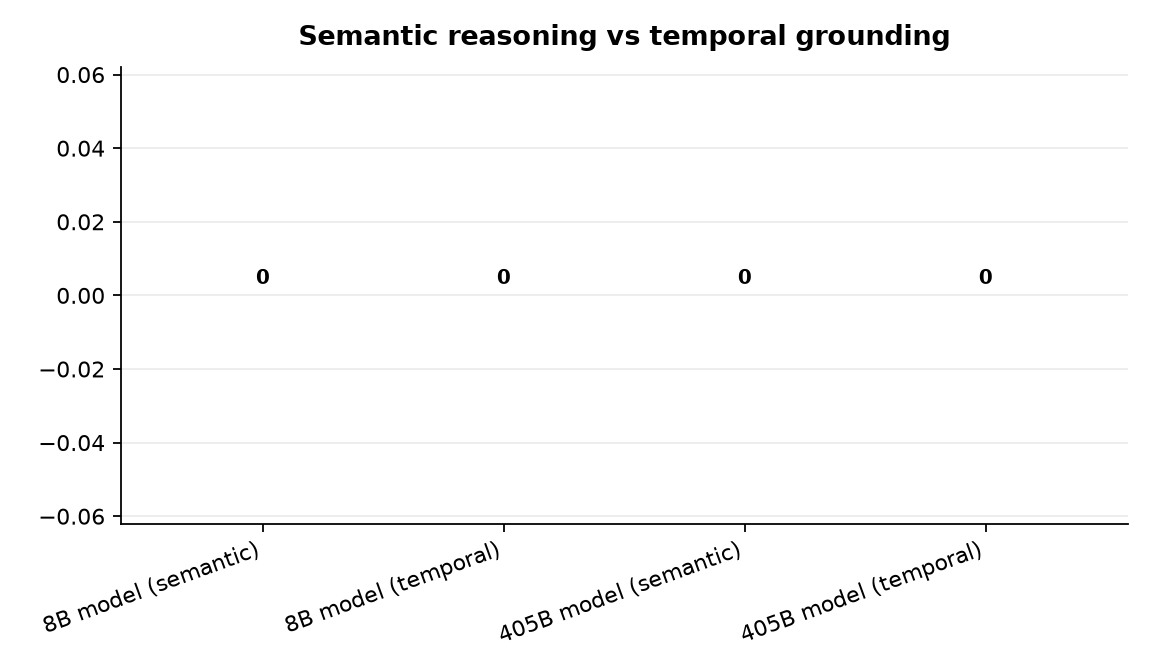
The paper's central finding is what the authors call a "localization paradox." I read through the full results table to understand what they mean, and the numbers are striking. Across models from GPT-4o, Gemini 2.0 Flash, and Llama 3.2, the researchers measured two capabilities separately: semantic reasoning (identifying the object or event the question describes) and temporal grounding (pinpointing the exact timestamp where it appears).
Semantic reasoning improves with model scale. Larger models are better at saying "yes, the person picked up a blue mug." But temporal grounding precision stays flat regardless of whether you scale up parameters, increase input resolution, or feed more frames per second. An 8-billion-parameter model is about as accurate at timestamping events as a 405-billion-parameter model, within the statistical noise of the measurement. This contrasts with models that achieve gains through specialization rather than scale.
That matters because a wearable assistant that can tell you "you did interact with that document" but cannot say "it was around 3 PM Tuesday" is practically useless for episodic memory retrieval.
The paper pinpoints the bottleneck. It is not in encoding individual frames but in the temporal aggregation mechanism. Models can identify a frame that contains a relevant event, but they lose the positional signal when stitching frames into a narrative. The same architectural pattern that makes transformers good at understanding the gist of a scene also makes them bad at preserving where exactly in a 30-minute stream that scene occurred. This is exactly the type of temporal understanding that models like Nvidia's AV-Flamingo aim to improve.
What the benchmark tests differently
Existing egocentric video benchmarks, like Ego4D's episodic memory tasks, evaluate models in an offline, search-oriented setting. An agent sees the entire video and all questions at once. S-EMBER instead formalizes "grounded streaming episodic retrieval," where the model processes a continuous stream and must answer questions triggered by visual events without re-scanning the entire past.
This mirrors human attention: you can only recall what you noticed the first time.
The benchmark also supports flexible response lengths to simulate natural human-AI interaction. A correct answer might be a precise timestamp or a narrative description, and the evaluation accounts for both.
Meta has released the dataset as facebook/S-EMBER on Hugging Face, though no models are currently cited as using it, likely because the benchmark is only a few days old. Its design choices, while novel, face the same scrutiny as previous industry standards that were later found incomplete.
S-EMBER reveals that semantic reasoning in video models keeps improving with scale, but temporal localization has flatlined. This has direct consequences for any wearable AI that promises to retrieve specific memories from long video streams, and suggests the "when" problem will not be solved by feeding more data or larger models.
Get the tech essentials in 3 minutes every morning
One email, every weekday, with what actually matters in AI and tech.