Alibaba's generative world model, in gray testing
One photo, a drivable 3D world: Alibaba's HappyOyster bets on persistence
Alibaba's HappyOyster 1.0 is billed as the first proactive real-time interactive open-world model, letting developers and creators build explorable virtual environments from text or images. The gray test offers SDKs for Android, iOS, and Web, and the real question is whether it can keep the world coherent for more than a minute.
Emmanuel Fabrice Omgbwa Yasse AI-assisted
2026-07-24 · Last updated: 2026-08-03 · 4 min read
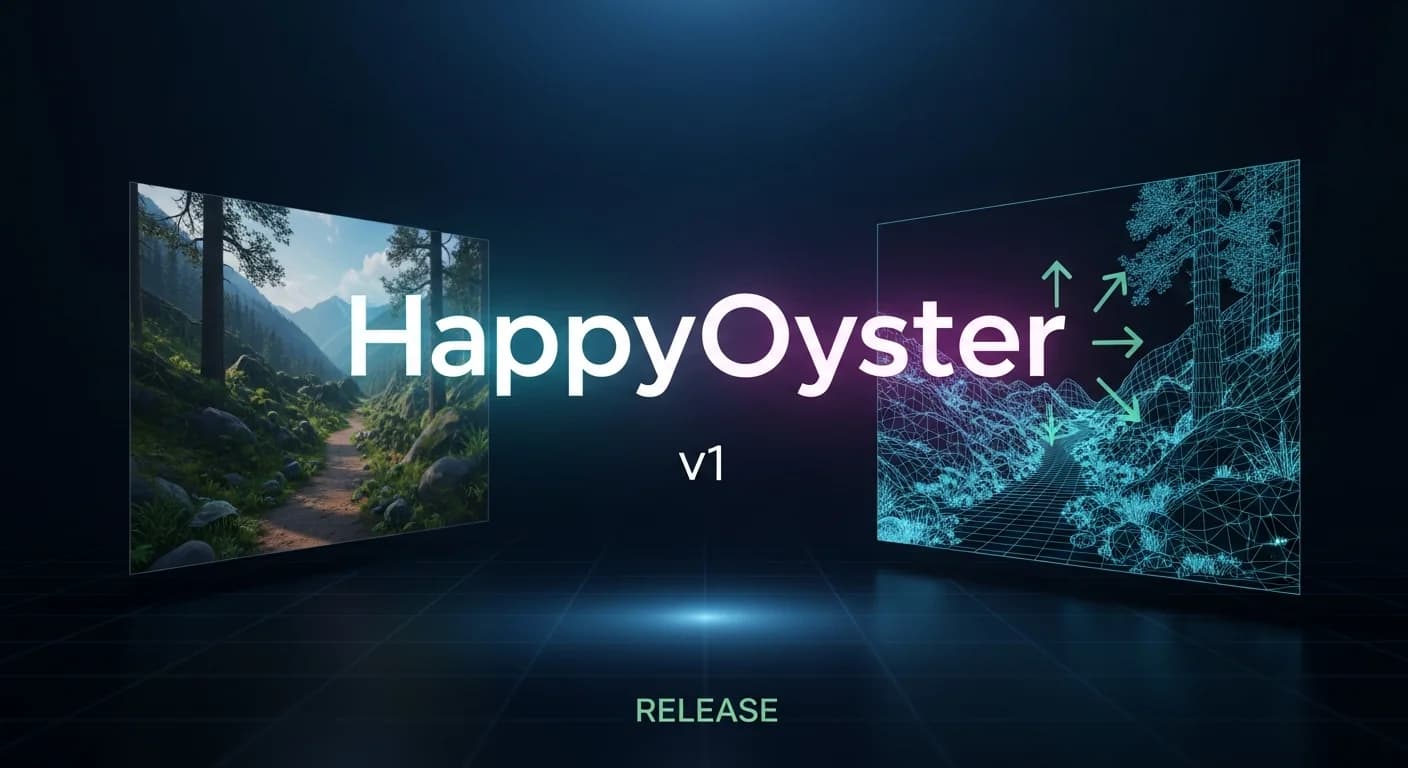
Alibaba's ATH research group released HappyOyster 1.0, calling it "the world's first proactive real-time interactive open-world model." Feed it a text prompt or a photo and it returns a 3D world you can walk through, drive across, and explore for over a minute, with synced audio and visuals. It is one of the more ambitious examples to come out of the lab so far. Alibaba's research arm has been betting on real-time multimodal output across the board, from Qwen2.5-Omni to data agents like QwenPaw-Data, and HappyOyster is the same bet applied to 3D space.
HappyOyster splits the experience into two modes. Adventure mode generates a complete open world with custom characters, then responds to user commands in real time. The demo scenario in Alibaba's announcement shows a desert landscape with driving physics, though the model could handle any environment described in the prompt. Directing mode turns the user into a virtual film director: text commands control camera angles, character movement, and plot progression, with the ability to pause, rewind, or rewrite the scene at any moment. That kind of live control over generated content is something most generative tools still struggle with. It's less like prompting a static image and more like Google Vids' actor-director model, except the whole world is generated on the fly.
The underlying architecture is not detailed in the release. What's clear is that HappyOyster is a generative system trained on multimodal inputs rather than a finite-state game engine, which means every interaction potentially generates new content instead of selecting from a pre-built library of responses. Whether that holds up under sustained use is something third-party testing will need to confirm. Two reference points frame the risk: SceneActBench found that even the best VLMs fail at 3D action, and Qwen's AgentWorld framework treats environments as language problems rather than physics simulations, a viable but untested approach at this scale.

HappyOyster 1.0 is now in gray testing, meaning access is limited to selected developers and enterprise partners. Alibaba published SDKs for Android, iOS, and Web, along with server-side Open APIs for managing virtual worlds. The client SDK handles RTC connections, video rendering, and both Adventure and Directing modes. Users can export footage after a session ends. The player can see every token spent and every frame generated, an unusual level of transparency that echoes Alibaba's Agentic OS observability, which shows developers exactly how their agents burn through tokens.
Reactor has signed on as the first official integration partner. The two companies formed a strategic partnership around product implementation and technical innovation. Reactor's exact role is not specified, but the partnership suggests a commercial path past the demo stage.
The release lists several target use cases. Game developers can prototype open worlds, character interactions, and combat sequences from images and prompts instead of building from scratch in a game engine. Interactive short dramas and AI digital companions sit in another category: users build characters and storylines through natural language, and the model handles the rest. Cultural tourism is listed as well, with immersive virtual experiences for visitors. The ambition lines up with what other labs are chasing. Sakana's Fugu-Cyber showed that raw models need orchestration to be useful in complex domains, a lesson the startup has built its strategy around, per this look at Japan's AI sovereignty play. HappyOyster is essentially applying the same multi-agent thinking to spatial generation.
None of these use cases are fully proven yet. The model is in gray testing precisely because the rough edges need sanding. Real-time interactive generation at this scale is computationally expensive, though Nvidia's Cosmos-H-Dreams runs real-time surgical simulation at 160 fps, which shows real-time interactive generation is feasible in demanding domains. Output quality depends heavily on the clarity of the prompt and the model's understanding of physics and scene composition, exactly the problem PhiZero tries to solve by teaching video models to reason in physics before they render. Alibaba's announcement is short on concrete metrics like generation time, resolution, or interactive latency.
For now, developers with access to the gray test can experiment. The model is a genuine attempt to push generative AI beyond one-shot outputs and into something that feels like a lived-in space. Whether it lives up to that ambition is what the gray testing period will show.
Get the tech essentials in 3 minutes every morning
One email, every weekday, with what actually matters in AI and tech.