Regulation
Apple let Brazil inside its walled garden. The gates cost extra.
Apple opens iOS in Brazil to alternative app stores and payments under a CADE agreement, adding new commission tiers and privacy warnings that signal the company isn't giving up its cut.
Emmanuel Fabrice Omgbwa Yasse AI-assisted
2026-07-29 · Last updated: 2026-08-03 · 4 min read
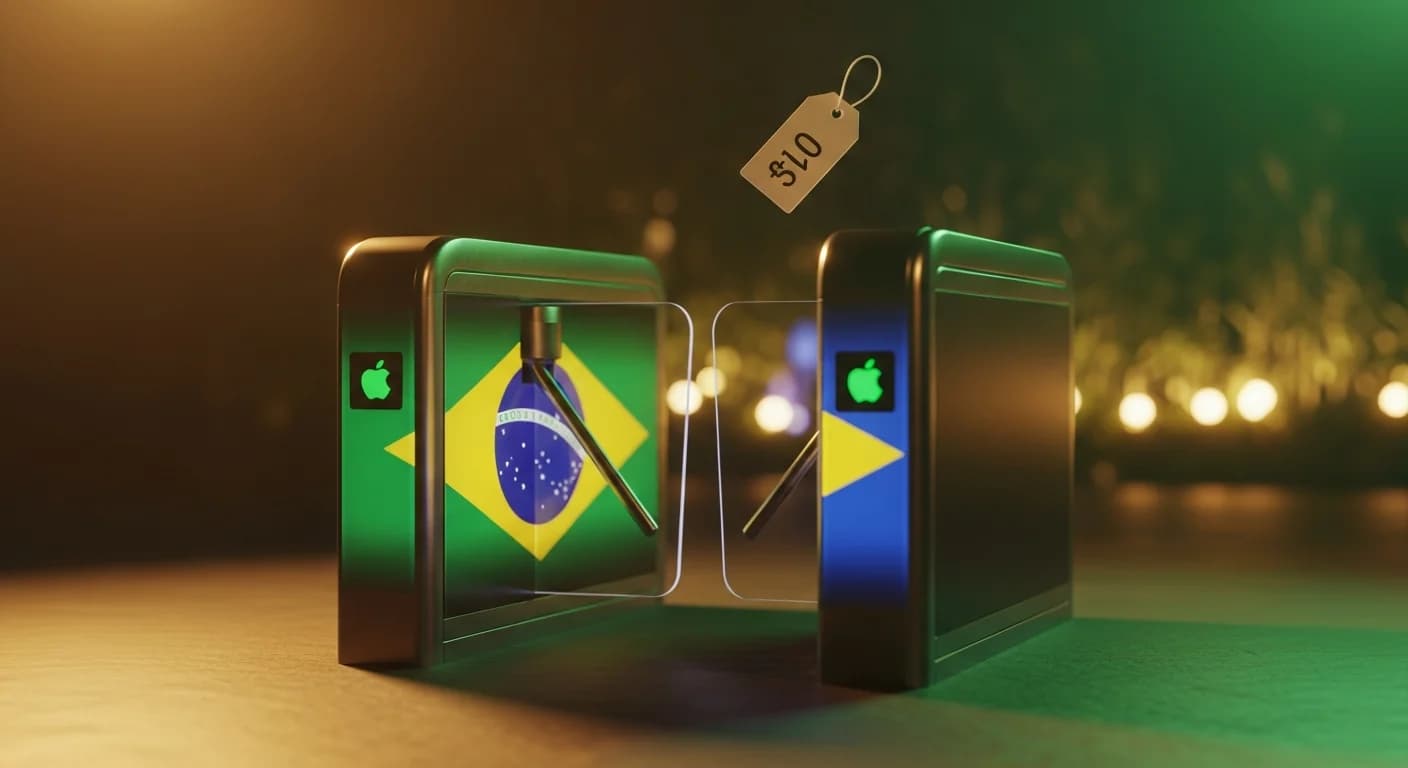
Apple's agreement with Brazil's antitrust authority CADE, announced June 18, 2026, forces the company to allow iOS users in Brazil to download apps from alternative marketplaces and use payment methods outside Apple's own In-App Purchase system. It is the first time Apple has made such concessions in South America, following similar moves in the European Union and Japan.
The changes apply immediately with iOS 26.5. Developers can now distribute apps through authorized alternative marketplaces and process payments through third-party systems or via links to external websites. Apple will continue to operate its own App Store alongside these options, as other platforms have shown that opening a walled garden doesn't mean abandoning control.
The fee structure
Apple is introducing a three-tier commission system that keeps its revenue streams intact even when it does not handle the transaction. Developers staying on the App Store and using Apple's payment system pay a 21% commission on digital goods and subscriptions, plus an additional 5% if they use Apple's payment processing, down from the previous 30% standard rate. Apple says most developers will qualify for the 10% small business rate.
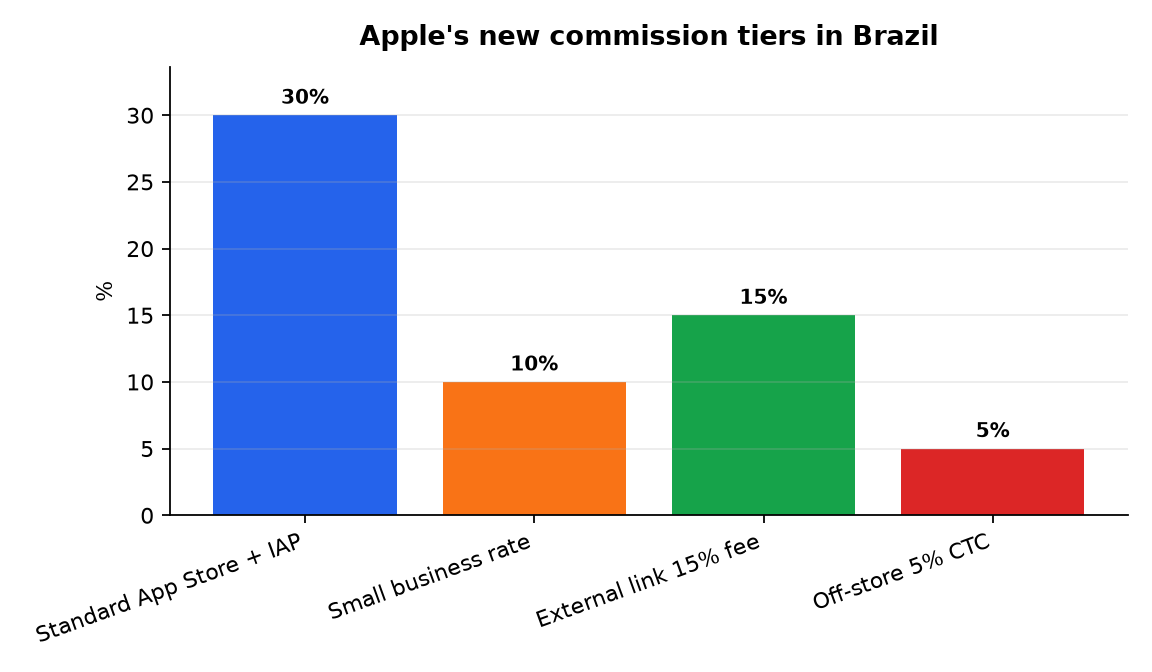
The new twist is a 15% commission on transactions completed on a developer's own website if the user got there via a link inside the App Store app. Apple calls this a "store services commission." Apps distributed entirely outside the App Store still owe Apple a 5% "Core Technology Commission" on digital sales.
Developers who do not sell digital goods pay nothing, as before.
Apple framed the arrangement as a compromise that protects users. The company said in a statement that Notarization, a baseline automated and human review process, will apply to all iOS apps in Brazil, though it conceded this is "less comprehensive than the App Review process that applies to all apps on the App Store."
Security risks acknowledged
Apple's press materials spend more space on warnings than on opportunities. The company explicitly says the new distribution channels "open new avenues for malware, fraud, scams, and privacy and security risks." Apps downloaded from outside the App Store "will not benefit from the same protections Apple provides through App Review." The emphasis on risk echoes how security tools approach vulnerability scanning by, at least, shining a light on what's exposed.
The company also highlights risks to children. Apps in the Kids category on the App Store will not be allowed to link to external websites for payments. Users under 18 who use alternative payment processing inside App Store apps must pass a parental gate before making a purchase. Apple is also building a new API so parents can monitor purchases made outside Apple's system.
Same playbook, new market
The structure closely mirrors what Apple implemented in the European Union after the Digital Markets Act took effect in 2024. In both cases, Apple preserved its core commission model by relabeling some fees and adding a technology levy on off-store sales. The EU version includes a Core Technology Fee of €0.50 per first annual install; Brazil's is a percentage of revenue rather than a per-install charge, which may prove less onerous for free apps that monetize through ads. The strategic pattern of accepting new rules while keeping the same economics is not unlike how large-scale AI models restructure costs without abandoning their revenue logic.
What is different is the tone. The EU rollout was preceded by months of public sparring between Apple and the European Commission. In Brazil, Apple appears to have negotiated the terms with CADE before announcing them, presenting the package as an agreement rather than a concession.
Still, the practical effect is the same: Apple has preserved its ability to collect a commission on most transactions involving digital goods, even when it does not process the payment or distribute the app. The question now is whether developers in Brazil will treat the alternative channels as a genuine escape from Apple's ecosystem or as a marginal option used only by the largest players who can justify the engineering cost, a dilemma that platform dependency debates across tech ecosystems continue to explore.
For developers weighing the move, the calculus isn't unlike choosing between models on a leaderboard: the headline numbers matter, but the real cost hits when you look at the fine print. Whether the new tiers actually reduce fees compared to Apple's old 30% depends entirely on how users behave and where a given app lives within the ecosystem.
Get the tech essentials in 3 minutes every morning
One email, every weekday, with what actually matters in AI and tech.