Moonshot AI's scheduler for automated agent tasks
Your AI tasks now schedule themselves. Kimi Work ships a cron engine.
Kimi Work adds a built-in cron engine to the Kimi AI platform, enabling scheduled execution of LLM calls, data processing, and agent workflows. It targets users who need 24/7 automation without local infrastructure.
Emmanuel Fabrice Omgbwa Yasse AI-assisted
2026-07-21 · Last updated: 2026-07-30 · 2 min read
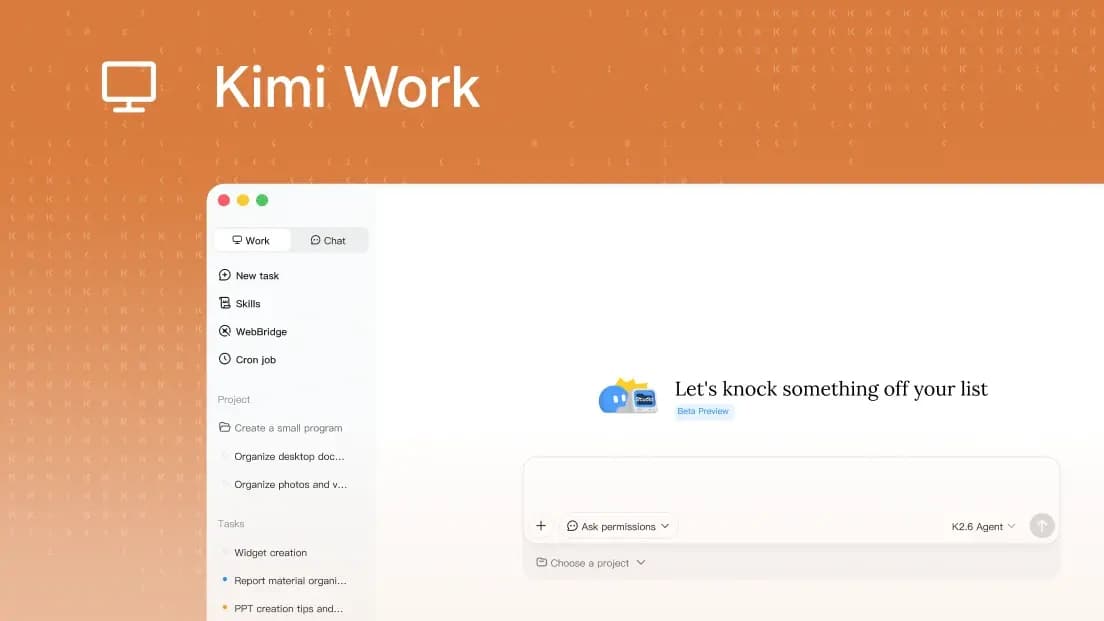
Kimi Work is now live on Moonshot AI's platform. It runs LLM calls, Python scripts, and similar tasks on a cron timer. No need to keep a local machine running.
Define a recurring task and a schedule, and Kimi Work handles the execution in the background. This covers early-morning briefings, midnight dataset passes, regularly scheduled data pulls, anything that forces someone to start a job and wait for it. Now it runs unattended.
Because Kimi Work is built into the existing cloud infrastructure, users avoid provisioning servers, installing schedulers, or leaving a laptop running. Kimi Claw already allowed browser automation without local setup; Kimi Work applies the same principle to scripted and LLM-driven tasks. This decision fits into broader questions about who controls AI infrastructure.

This is more than a convenience feature. It signals a shift in how AI platforms approach workflow. Most API-based agents need a server-side scheduler or an always-on client. Kimi Work integrates scheduling into the product layer, so users can skip writing cron files or managing infrastructure. Competitors like Groq are also building toward agent operating systems, from a different angle, as noted in Japan's orchestration approach.
The real test is trust. An unattended LLM call returning stale data or a hallucinated report is worse than no report at all. Kimi Work schedules execution, but output quality rests on the model and prompt design behind each task. Evaluating AI outputs at scale remains a challenge, as research on orchestration and evaluation shows.
Who is it for?
Kimi Work suits teams with regular, well-defined reporting needs: daily market summaries, nightly code analysis, weekly data aggregation. Solo developers can also decouple batch processing from their own work hours. The growing adoption of Kimi models on platforms like Opencode points to a user base ready for deeper integration, similar to how Chinese AI labs are gaining ground.
Users who need event-triggered workflows (run task X when file Y changes) will still need an external orchestrator. Kimi Work is purely schedule-driven, not event-driven.
Pricing details are still vague: Kimi Work is included in existing platform tiers, and the feature is available now. The launch follows high demand that led to subscription pauses last month, as covered in the K3 model coverage.
Get the tech essentials in 3 minutes every morning
One email, every weekday, with what actually matters in AI and tech.