Edge AI
Mistral Nano runs on $80 hardware and matches 85% of its bigger sibling. That gap decides everything.
Mistral AI's new Mistral Nano targets edge devices with under 1GB of RAM, achieving 85% of the reasoning performance of its larger Mistral Small model. That 15% gap is either irrelevant or decisive, depending on what you need it to do.
Emmanuel Fabrice Omgbwa Yasse AI-assisted
2026-07-25 · Last updated: 2026-08-03 · 4 min read
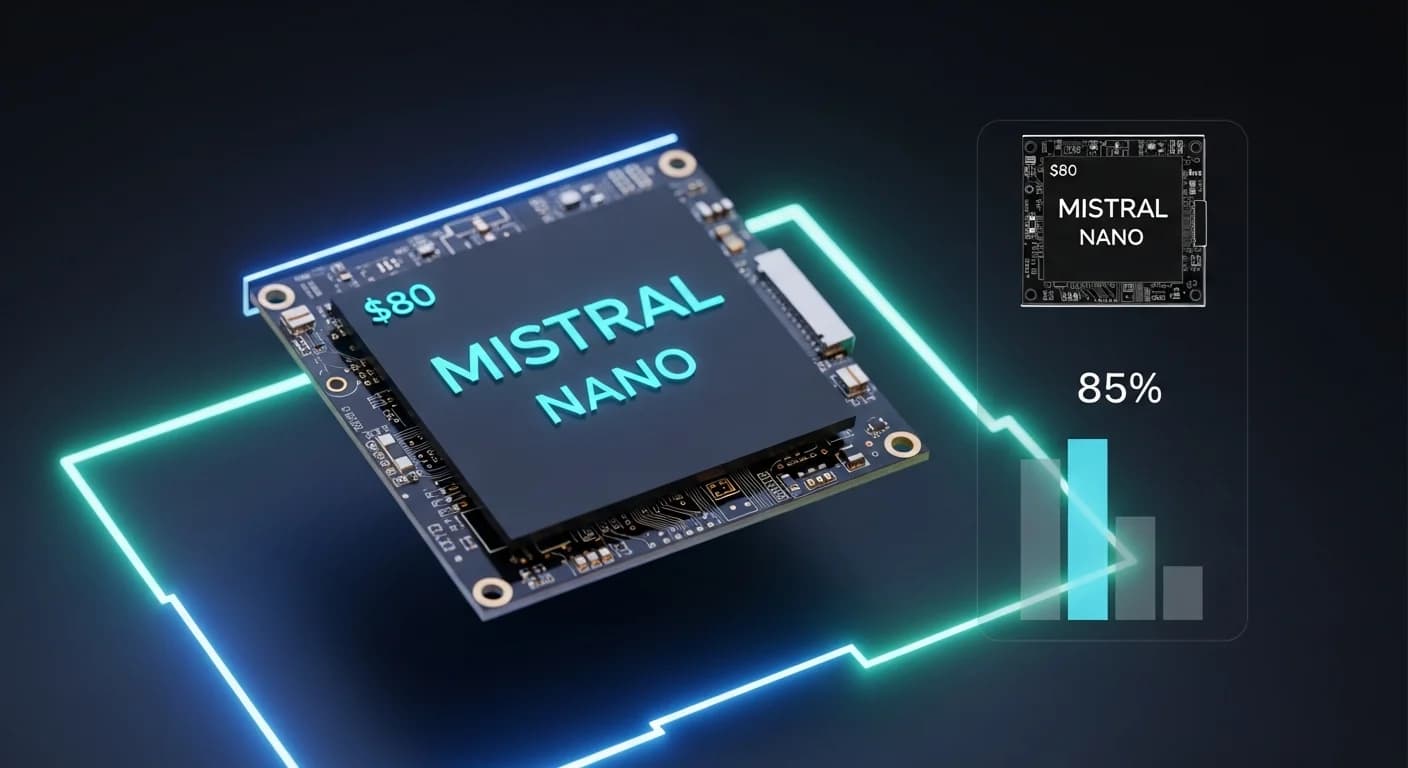
Mistral AI quietly introduced a new small language model aimed at running on constrained hardware. Mistral Nano is designed for edge devices, including smartphones, IoT sensors, and embedded systems, where memory and compute are limited. The company says it can operate with under 1GB of RAM while retaining 85% of the performance of its larger Mistral Small model on standard reasoning benchmarks, a claim that fits a pattern of efficiency-focused releases across the industry, from Alibaba's phone-runnable Qwen2.5-Omni to Google's three-model Gemini drop.
The announcement comes as the industry increasingly debates whether smaller, more efficient models can replace the brute-force scaling approach championed by companies like OpenAI and Google. Mistral's own track record already challenged that orthodoxy: earlier this year, its 12B-parameter model outperformed a 90B-parameter competitor on several tasks. Mistral Nano extends that logic to the edge, where every megabyte of memory and milliwatt of power matters. That efficiency-first bet mirrors the economic shockwave from Kimi K3, which showed that one open-weight model can force a global revaluation of AI's cost assumptions.
The specific architecture, parameter count, and training data remain undisclosed. Mistral says only that Nano is a transformer-based language model optimized for low-latency inference on ARM-based and x86 edge processors. The model's strength appears to be on reasoning tasks that measure logical deduction and common-sense understanding, though Mistral has not published a detailed breakdown of the benchmarks used.

The edge AI market has become a battlefield for efficiency-focused releases. Google released Gemini Nano as part of its Pixel lineup last year, and Apple's on-device models power features like on-device dictation and image description in iOS. Mistral's entry positions it to compete in industrial IoT, automotive infotainment, and consumer devices where privacy constraints demand local processing. For developers evaluating Nano against these options, the practical question is whether a model running on modest hardware can handle real-world tasks, a theme explored by PawBench's findings on agent harness versus model brain.
Mistral Nano is available for download from Hugging Face under an Apache 2.0 license, making it suitable for commercial and hobbyist use without per-call licensing fees. The model is packaged in a framework-agnostic format that supports ONNX Runtime and CoreML on Apple hardware, and TensorFlow Lite on Android and Linux devices.
The release also comes with a reference implementation for Raspberry Pi 5 and similar single-board computers, suggesting Mistral is aiming at the maker and industrial prototyping crowd as much as at smartphone OEMs. A technical note accompanying the release claims that Nano's inference latency on a Raspberry Pi 5 is under 100 milliseconds for single-turn responses of up to 100 tokens, though the company warns that performance will vary by task and system load.
This model is not Mistral's only recent expansion beyond text. In June, the company acquired Emmi AI, an Austrian physics simulation startup, to bring real-time simulation and digital twin capabilities to industrial engineering. And its Pixtral-12B vision-language model, released earlier this year, demonstrated that Mistral can handle multimodal inputs without ballooning memory requirements. Mistral Nano fits neatly into that pattern: an efficiency-first release that tests a lower bound the company hasn't tried before. That same drive toward multimodal efficiency appeared in Alibaba's Qwen-Image-3.0, which prioritized legible text and dense layouts over aesthetic polish.
The benchmark gap between Nano and Small raises a practical question: is 85% enough? For many edge use cases, the answer is almost certainly yes. A device that can classify user commands, run simple Q&A, or power a chatbot for help documentation does not need the top 15% of GPT-level reasoning. The tradeoff becomes real only for tasks that require multi-step reasoning or external knowledge retrieval, where the model's smaller context window and reduced capacity start to show. This mirrors the debate explored by LiveBench's top-four tight scores and brutal cost differences, where small margins in benchmark scores belie huge gaps in practical deployment cost.
Mistral has not announced a commercial licensing tier for Nano, though the Apache 2.0 license already grants broad rights. The company may offer a managed API endpoint for developers who want higher throughput without managing their own hardware, but for now the model is self-hosted or local only.
What's notable about Nano is not the performance claim itself, 85% is impressive for a model that runs on a fraction of the silicon, but the direction it signals. Mistral is betting that the future of AI is not bigger data centers but smaller devices, and that an open model that works on an $80 single-board computer matters more than a closed one that needs a $100,000 GPU cluster. That bet is backed by a growing roster of OEM partners and a research team that has consistently produced efficient architectures.
Whether the 15% gap matters depends entirely on the application. For a factory sensor that needs to flag anomalies in real time, Nano may be all the intelligence required. For a legal document analysis agent, it will not be enough. Mistral's own internal testing suggests the gap narrows further on domain-specific fine-tuning, which could make Nano a viable base model for edge fine-tuning workflows.
Get the tech essentials in 3 minutes every morning
One email, every weekday, with what actually matters in AI and tech.