Analysis
The 0.8B model that just broke document parsing's pipeline monopoly
OvisOCR2 (0.8B parameters) from Tencent scored 96.58 on OmniDocBench, the first end-to-end model to top the leaderboard. The model uses reinforcement learning and distillation to outperform larger pipeline systems, challenging the necessity of multi-stage architectures.
Emmanuel Fabrice Omgbwa Yasse AI-assisted
2026-07-26 · 3 min read
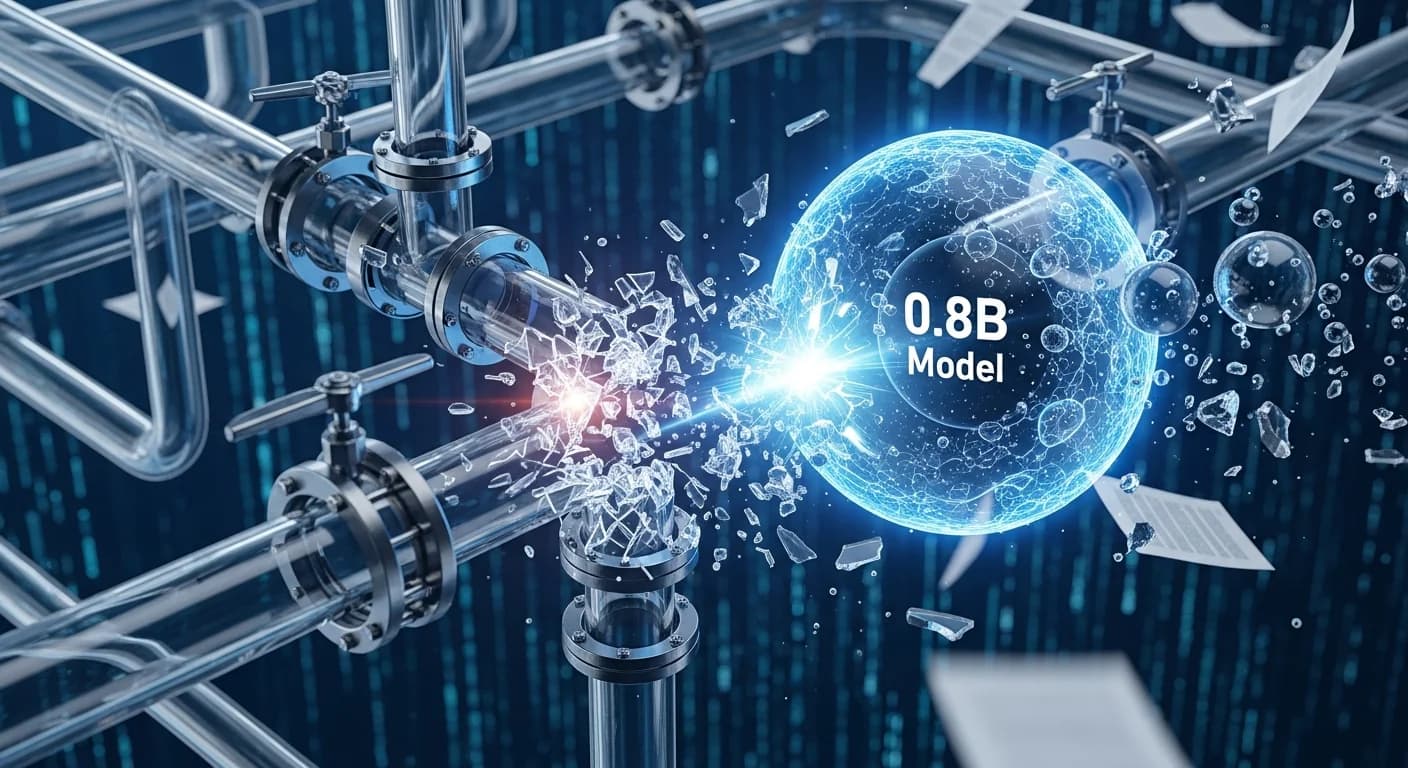
Document parsing has long belonged to pipeline systems. Chains of specialized modules. Text detector. Recognizer. Layout analyzer. Formula parser. Each step adds complexity and lets errors pile up downstream. The old assumption was that no single end-to-end model could match their precision, especially on messy real-world pages.
Tencent's OvisOCR2 challenges that assumption. At just 0.8 billion parameters, it scored 96.58 on OmniDocBench v1.6, the best overall mark for any method, pipeline or end-to-end. The technical report, posted July 15 on arXiv, reveals how they did it.

The training recipe is where it gets interesting. First, the team built a data engine that mixes filtered real document annotations with synthetic pages where both the image and the Markdown target come from the same HTML source, guaranteeing perfect alignment. After supervised fine-tuning, they trained a 4 billion parameter branch using reinforcement learning with a multi-component reward that scores accuracy, structure, and formatting. They then distilled that knowledge into the 0.8B model through on-policy distillation and fused weights from multiple checkpoints. The result: an end-to-end model that beats methods that often use five times as many parameters and separate modules, echoing a pattern seen in other compact models like Alibaba's Qwen2.5-Omni.
The result holds up beyond the leaderboard. On PureDocBench, OvisOCR2 scored 75.06, the highest Avg3 among compared methods. An internal benchmark with more diverse and challenging layouts also showed the model keeping its lead, suggesting the approach generalizes beyond curated test sets.
The trend toward end-to-end designs is clear. DeepSeek-OCR 2 and Mistral OCR 4 both offer open-source document parsing, but neither has claimed the top spot on OmniDocBench with an end-to-end model at this scale. DeepSeek-OCR 2 uses dynamic resolution and visual tokens; Mistral OCR 4 adds bounding boxes and per-word confidence scores. Both hedge toward pipeline-like structure. OvisOCR2 is pure end-to-end: page image in, Markdown out, no intermediate boxes or stages. The success of this small open-weight model also feeds into a broader disruption of AI cost assumptions, as the $314 billion assumption analysis discusses.
For developers building document workflows, a single 0.8B model that handles text, tables, formulas, and layout in one pass simplifies infrastructure and cuts latency. It also lowers the barrier for edge devices and low-resource environments. This aligns with cost-cutting initiatives like Qwen Cloud's Token Plan, which bundles model access to streamline spending.
Some open questions remain. The paper does not specify training compute cost, inference speed, or the exact composition of the synthetic data. The model is available on GitHub, but the preprint's repository link is incomplete. Independent reproduction and latency benchmarks will determine whether the 96.58 score holds up in real-world throughput. This gap between benchmark and production is a known issue, as a production reality check on agentic systems highlights.
Still, OvisOCR2's result marks a milestone. It proves that with enough data quality and a smart training pipeline, small end-to-end models can compete with, and beat, modular systems that have racked up years of optimization. The ball is now in the pipeline camp's court to justify their complexity.
- Source : OvisOCR2 Technical Report
Get the tech essentials in 3 minutes every morning
One email, every weekday, with what actually matters in AI and tech.