Developer Tools
The boring update that matters: why polish won the developer tools race
xAI's Grok Build CLI release focused on bug fixes and tutorials, while Apple's Xcode 27 supports multiple AI providers through a language model protocol. These moves signal that developer tools have entered a maturity phase where polish and seamless integration define competitive advantage.
Emmanuel Fabrice Omgbwa Yasse AI-assisted
2026-07-26 · 4 min read
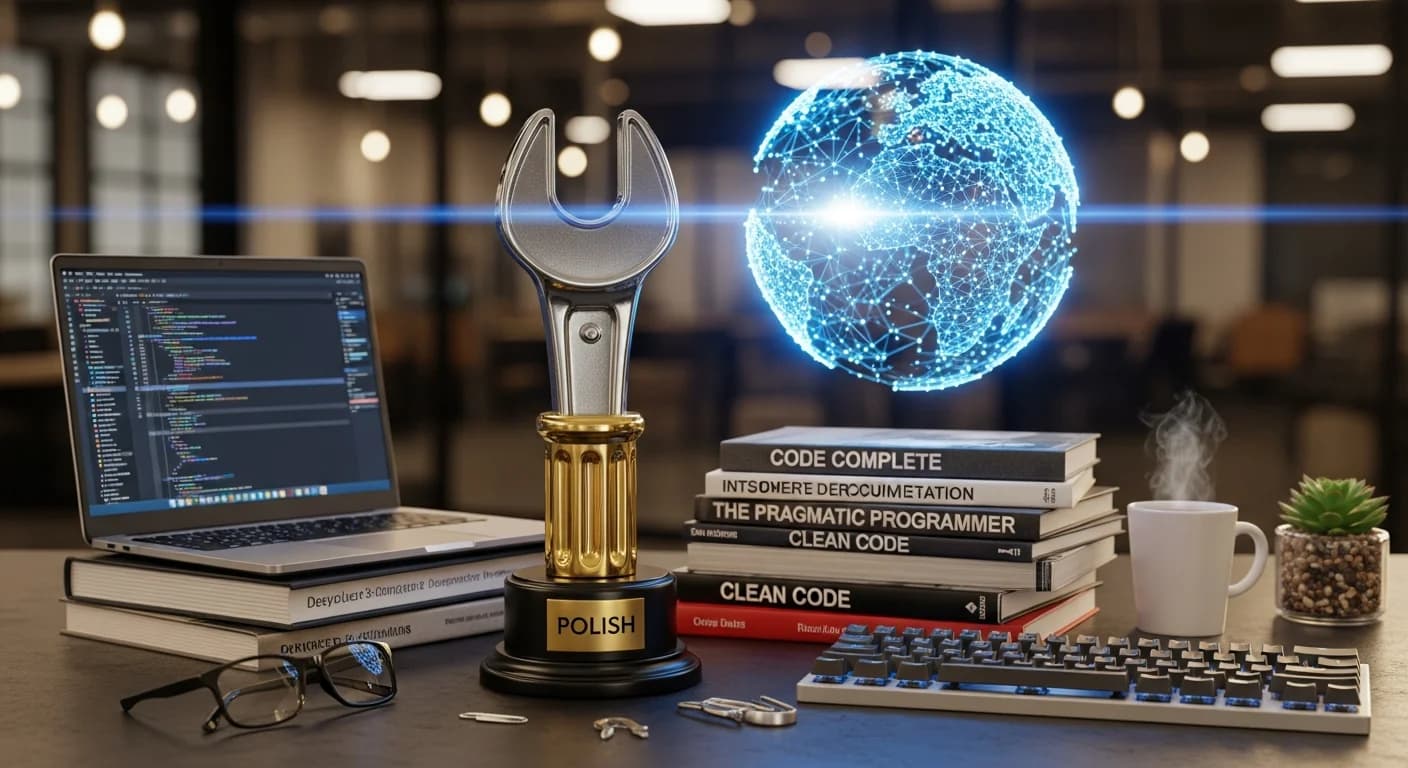
The maturity shift: why stability is the new differentiator
For years, developer tools fought on features alone. Every release promised something new: a faster loop, a smarter autocomplete. That race hasn't stopped, but the winners now are often the ones who stop adding and start polishing. Two examples from opposite ends of the stack make the case. xAI's Grok Build CLI update landed without a marquee feature. Apple's Xcode 27 introduced a way to plug in multiple AI providers instead of locking developers into one stack. Both decisions value integration and reliability over novelty. That tradeoff is the signature of a market maturing.
Neither move is flashy. Both are what a production tool needs now: fewer sharp edges, better documentation, and seamless connections between the pieces developers already use. The competitive advantage lies in how well a tool disappears into the workflow, not how loudly it announces itself.
Grok Build CLI: a case study in bug-fix-focused releases
The v0.2.112 changelog for Grok Build CLI runs two dozen bullet points. Resumed conversations no longer drop attachments. Background shell commands report real exit codes. The tasks tray clears killed processes properly. Forking a session preserves the environment. These aren't blog buzz items. They're the kind that keep a developer from throwing their keyboard across the room. For more on how polish beats features, see the dedicated analysis of this very update.
The release also added a tutorial and expanded configuration. The tutorial lowers the barrier for new users without requiring them to piece together undocumented behavior. Configuration flexibility matters because real projects have constraints defaults can't anticipate. Together, the fixes and additions signal that xAI treats Grok Build CLI as a production tool, not a demo. A tool that breaks mid-build loses trust faster than one that lacks a feature. xAI seems to understand that trust is more valuable than velocity, a lesson echoed by the gap between benchmark success and production reliability in agentic systems.
Apple's controlled openness: the Language Model Protocol and Xcode 27
Apple's approach at WWDC 2025 was typical: strategic. Xcode 27 will natively support coding agents from Anthropic, Google, and OpenAI, and new intelligence frameworks let apps tap models from Claude, Gemini, and any provider that implements Apple's language model protocol. This isn't a bet on any single AI vendor. It's a bet on the protocol itself, making integration so seamless that the provider becomes an implementation detail. Apple's walled garden gate with an AI-shaped key describes the strategic implications in more depth.
The new Core AI framework lets developers run full-scale LLMs on-device. Combined with the protocol, app makers get a choice: use Apple's own models, bring in a third-party checkpoint via the same framework, or connect to a cloud service. That flexibility is more valuable than any single AI feature Apple could have built in house. It keeps Apple in control of the developer experience without having to out-innovate every lab. The walled garden just got a gate, and the gate uses a key that many companies can cut.
Seamless integration in practice: Pixelmator Pro and the Creator Studio
The June 2026 Creator Studio update shows that integration-first philosophy in action. Pixelmator Pro, which Apple acquired in late 2024, now works as a shared image editor across Final Cut Pro, Keynote, Pages, and Numbers. A video editor can send a frame to Pixelmator Pro, adjust it, and drop it back into the timeline. A presentation designer edits a graphic without leaving Keynote. That direct-edit link is the kind of polish that builds durable advantage. Once a workflow depends on that round-trip, switching hurts. For a broader look at how this fits into Apple's strategy, see the Creator Studio update coverage.
The update also brought on-device AI captioning and edit detection to Final Cut Pro, and shape generation across the productivity suite. These features aren't revolutionary. They're thoughtfully integrated capabilities that save minutes per day, compounding into hours per month. Apple understands that retention comes from invisible productivity gains, not splashy launch slides.
What developers should prioritize now
The evidence from these two companies points to a clear pattern. When evaluating a tool, weigh documentation quality, bug-fix release frequency, and integration depth at least as heavily as the feature count. A tool that fixes twenty bugs and adds a tutorial is more likely to survive a year of real use than one that ships a hundred features with rough edges.
Integration depth matters because software is never used in isolation. The ability to send a frame from Final Cut Pro to Pixelmator Pro and back is not a spec sheet line item. It's the difference between a tool that fits and one that fights. The protocol-based approach Apple takes with AI models mirrors that philosophy: clean connections, coexisting alternatives, developer choice.
The developer tools market is no longer about who can invent the next paradigm. It's about who can make the current paradigm work without friction. Grok Build CLI's bug-fix release and Apple's multi-provider protocol show the race has shifted. Polish won.
Get the tech essentials in 3 minutes every morning
One email, every weekday, with what actually matters in AI and tech.